135th meeting of the Committee of Ministers of the Council of Europe in Chisinau
15.05.2026
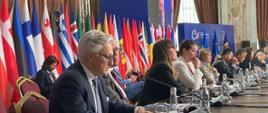
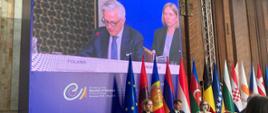
The 135th meeting of the Committee of Ministers of the Council of Europe took place in Chișinău on 14-15 May 2026. The Polish delegation was represented by Mr. Artur Harazim, Undersecretary of State at the Ministry of Foreign Affairs. The event concluded Republic of Moldova's six-month Presidency of the Committee of Ministers of the Council of Europe.

A key element of the meeting was the establishment of the Special Tribunal for Crimes of Aggression against Ukraine. The establishment of the second element of the compensation mechanism, after the Register of Damages, was made possible by the declaration of intent of 34 Member States and non-European countries to accede to the Enlarged Partial Agreement on the Management Committee of the Special Tribunal for Crimes of Aggression against Ukraine. Ministers also welcomed the broad support of states for the Convention establishing the International Claims Commission for Ukraine and encouraged further accessions to enable the swift launch of the compensation mechanism.
The Foreign Ministers of the 46 Council of Europe Member States also adopted a political declaration highlighting and clarifying key aspects of the European Convention on Human Rights, particularly in the context of migration. The text reaffirmed the deep and unwavering commitment of the Member States to the Convention and their support for the independence of the European Court of Human Rights. It also emphasized the need to maintain a balance between the general interest of the community and the rights of individuals.
Another significant achievement of the session was the approval of the Additional Protocol to the Council of Europe Convention on Laundering, Tracing, Seizure and Confiscation of the Proceeds from Crime and on the Financing of Terrorism (hereinafter referred to as the "Warsaw Convention"). This Protocol modernizes the legal and institutional framework for asset recovery in response to increasingly sophisticated, cross-border, and technologically advanced criminal networks. It enhances authorities' ability to monitor and disrupt suspicious transactions and confiscate assets, including cryptocurrencies, obtained through criminal activity.
Additionally, approval was given to prepare a new legal instrument addressing information manipulation and foreign interference.
Opening the session, Deputy Prime Minister of the Republic of Moldova, Mihai Popșoi, recalled the presidency's priorities: support for Ukraine, countering disinformation and foreign interference, and strengthening security and the resilience of democracy.
The Secretary General of the Council of Europe, Alain Berset, stressed during the ministerial session that Europe's strength lies in the complementarity of its institutions and in our common commitment to democratic security.
Poland's representative at the session, Deputy Minister Artur Harazim, emphasized in his address that in times of growing geopolitical tensions, the Council of Europe's mission is more important than ever. Human rights, democracy, and the rule of law—the foundations of Europe's security for decades—are under increasing pressure and, in some cases, are the subject of overt attacks. Nowhere is this more evident than in Ukraine, he added. The head of the Polish delegation also spoke about the challenges of foreign information manipulation and hybrid activities, which Poland grapples with on a daily basis. He also spoke about migration, which is being used as an instrument to destabilize democratic states.
As is customary, the ministerial session concluded with the handover of the Council of Europe Presidency. Monaco will hold the Presidency from May to November 2026.