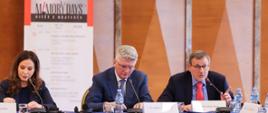
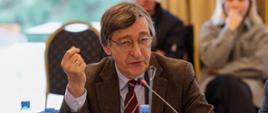
Prof. Jan Skórzyński at the 11th edition of Memory Days 2026
25.02.2026
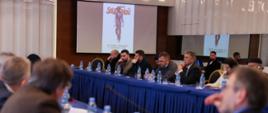
On February 19-21, Tirana hosted the 11th edition of Memory Days, a recurring event dedicated to commemorating the era of communist totalitarianism in Albania and its victims. Organized annually by the Albanian Institute for Democracy Media and Culture with the support of the Konrad Adenauer Foundation, Memory Days is primarily a forum for debate on history, the trauma left by communist dictatorships, and its impact on subsequent generations. This year's edition, organized on the 35th anniversary of the toppling of the Enver Hoxha monument in Tirana, brought together historians, experts, and representatives of institutions from Poland, Germany, Hungary, Romania, Bulgaria, and other countries.

Poland was represented by Prof. Jan Skórzyński, historian, journalist, and expert on the history of Central and Eastern Europe, who spoke on the panel “Falling Symbols – Experiences of Transformation.” Professor Skórzyński specializes in the history of opposition movements in the People's Republic of Poland in 1956-1989 and the political thought of the anti-communist opposition in Poland. His academic work also covers issues of totalitarianism, democratic transformation, opposition to communist and authoritarian systems, the history of the People's Republic of Poland, and the Solidarity movement.
The introductory part of the panel featured speeches by Jonila Godole, director of the Institute for Democracy Media and Culture, Agron Gjekmarkaj, deputy speaker of the Albanian parliament, and Wojciech Unolt, chargé d’affaires a.i. of the Republic of Poland. During the panel debate, Prof. Jan Skórzyński spoke about the Polish experience of political change – the role of the democratic opposition and Solidarity, the Round Table talks, the elections of June 4, 1989, and the formation of the first non-communist government of Tadeusz Mazowiecki. He drew attention to the Polish specificity of the “negotiated takeover of power” – a process symbolized not by a toppled monument or wall, but by a ballot paper.
On the sidelines of Memory Days, Prof. Jan Skórzyński met with a group of Albanian historians and experts at the initiative of the Polish Embassy, with whom he discussed, among other things, various interpretations of “Albanian Stalinism” – an exceptionally brutal and long-lasting version of communist dictatorship, which collapsed only two years after the changes in the Soviet bloc countries. The discussion also focused on ways of preserving the memory of the communist past and passing it on to new generations.