The Baltic Sea - the maritime stronghold of Europe
03.10.2025
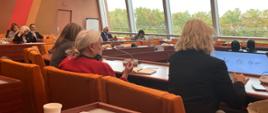
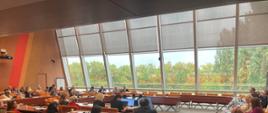
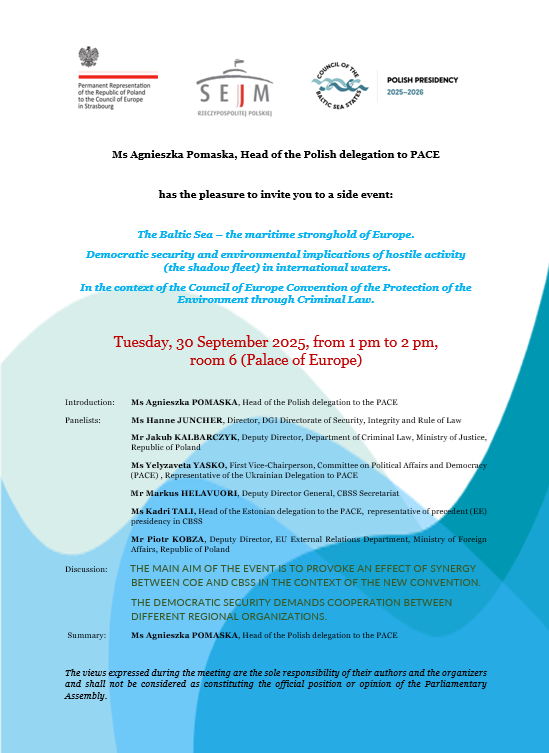
On 30 September, the Council of Europe held a debate entitled "The Baltic Sea - Europe's stronghold". Democratic security and environmental consequences of shadow fleet activity in international waters. In the context of the Convention on the Protection of the Environment through Criminal Law”. The event was co-organised by the Permanent Representation of the Republic of Poland to the Council of Europe in Strasbourg and the Sejm of the Republic of Poland.

In connection with Poland's assumption of the presidency of the Council of the Baltic Sea States on 1 July this year, as well as the development by the Council of Europe's Committee of Experts on the Protection of the Environment through Criminal Law (PC-ENVI) of a new convention of the same name, a debate was organised with the participation of parliamentarians, representatives of the Council of Europe Secretariat and the Polish Ministry of Justice and Ministry of Foreign Affairs, highlighting the synergy of the two organisations' activities in the area of environmental protection and the protection of our democracies against hostile actions by external entities.
The chair of the Polish delegation to the Parliamentary Assembly of the Council of Europe, Ms Agnieszka Pomaska (moderator of the debate), pointed to the need for cooperation between the Baltic states on threats in the Baltic Sea (including shadow fleets). The statements of the other participants elaborated on this proposal. Ms Hanne Juncher, Director of the DGI Secretariat of the Council of Europe, listed the most important assumptions of the future Convention on the Protection of the Environment through Criminal Law, mentioning, among other things, 19 categories of crimes against the environment and human rights. The representative of the Ministry of Justice, Deputy Director Mr Jakub Kalbarczyk, spoke about the contemporary challenges related to the prosecution of environmental crimes, including crimes in the Baltic Sea, and in particular the importance of cooperation between all Council countries in the area of criminal law. The presentation by the Deputy Director of the EU External Relations Department (MFA), Mr Piotr Kobza, highlighted the problem of the shadow fleet as a phenomenon posing an international threat to the Baltic Sea states and beyond.
The next panellists, Markus Halavuroi (Deputy Director of the CBSS Secretariat) and Ms Kari Tali (Chair of the EE delegation to the PACE) presented the main activities of the CBSS in the field of environmental issues and security in the Baltic Sea. The last panellist was Ms Yelizaveta Yasko, representative of the Ukrainian delegation and author of the report ‘The role of sanctions in countering the Russian Federation's war of aggression against Ukraine’. Her presentation aimed to show the broader political context of hostile actions by external actors. The Permanent Representative of the Republic of Poland to the Council of Europe, Mr Aleksander Pociej, mentioned the threats associated with the cutting of submarine cables located also in international waters (high seas) – this is one of the threats associated with the activity of the so-called ‘shadow fleet’ and concerns not only the Baltic Sea.
The debate concluded with an informal declaration on the need to include the issue of combating threats in the Baltic Sea in the agenda of the Council of Europe bodies, which is an area of interest to both the Council of the Baltic Sea States and the Council of Europe.