The ban on the import of products containing harmful substances will soon be implemented in Poland as well
16.01.2026
On the initiative of the Minister of Agriculture Stefan Krajewski, a regulation on temporary suspension of import and the placing of products containing harmful substances (active plant protection products) on the Polish market, which are unacceptable for use in the EU, is being prepared.

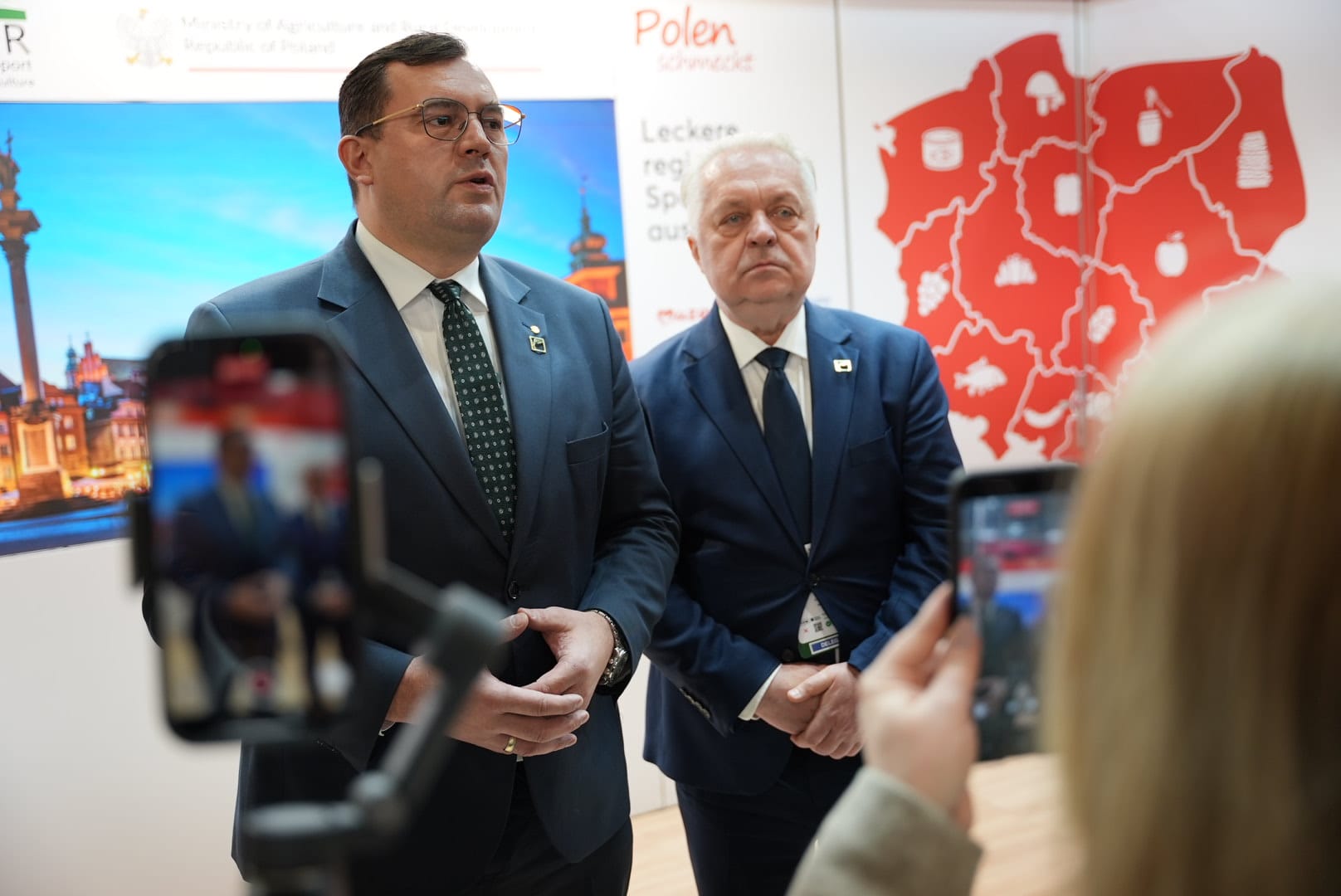
– We cannot allow a two-speed Europe. On the one hand, our farmers, processors and producers must meet increasingly higher norms and standards, on the other hand, we open the door to products that are exempt from these obligations. I have repeatedly pointed to the necessity to align these requirements and the need to introduce mirror clauses. Today, we have a situation in which we no longer appeal, but we act on our own. In cooperation with the Ministry of Health, I would like to introduce regulations prohibiting the import of commodities and products containing pesticide residues. Consumer safety is the most important – said the Minister of Agriculture Stefan Krajewski today, after opening the Polish stand at the Grüne Woche Fair in Berlin.
At the same time, the Minister confirmed that the Ministry of Agriculture had already provided the Ministry of Health with the necessary information about establishing specific requirements for foodstuffs, concerning residues of active substances of plant protection products, which was the basis for issuing a relevant regulation in Poland and informing the European Commission about this action. The regulation, initiated by the Minister of Agriculture Stefan Krajewski, is issued by the Minister of Health, in accordance with his competence, pursuant to the Act on food and nutrition safety.
– Food safety is as important as military security or energy security. Poland has opposed the Mercosur agreement from the very beginning, we did everything to block this agreement, but being also aware of various geopolitical interests – we secured protective clauses and security brakes for farmers in advance. But we have not said the last word yet; we are waiting for the European Parliament’s action consisting in lodging a complaint with the CJEU and this is the first step. If it is not effective – such a complaint will be lodged by the Polish government – said Minister Stefan Krajewski and confirmed the ongoing work on further solutions that were to reduce the negative effects of the agreement with Mercosur countries.
New regulations protecting the Polish market
The regulation regarding the temporary ban on the import of food products containing residues of selected plant protection products to Poland concerns substances whose application has been prohibited in the European Union for many years and is in force in European food law. The ban is time-limited, although it is possible to extend it and on this basis Poland wants to block, in the first instance, the import of products containing 5 active substances: carbendazim, benomyl, glufosinate, thiophanate-methyl and mancozeb.
In the next step, the Ministry of Agriculture will submit an application for the ban on further active substances, and the Institutes subordinate to the Ministry (Research Institute of Horticulture and Institute of Plant Protection) will be involved in their ultimate selection. According to the findings, the Ministry of Agriculture will finance the testing of samples taken by the Sanitary and Epidemiological Station from products placed on the Polish market from third countries, and the tests themselves will be conducted in the Institutes supervised by the Ministry of Agriculture.
At the same time, the issue of the ban on products containing pesticide residues, introduced by France, will be discussed at an extraordinary meeting of the Standing Committee on Plants, Animals, Food and Feed (SCPAFF) to be held in Brussels on 20 January. The meeting will also be attended by a representative of Poland, who will present our position of strong support for the actions taken by France.
Which products will be covered by the Regulation
Let us remind that in the EU, there are bans on the use of:
- carbendazim, since 2014;
- benomyl, since 2002;
- glufosinate, since 2018;
- thiophanate-methyl, since 2020
- mancozeb, since 2021
This means that after the entry into force of the prepared regulation, in Poland it will not be possible to trade in goods containing residues of the above-mentioned active substances, which most often include such products as:
- grapefruit, orange, lemon, lime, clementine, tangerine, apple, pear, quince, medlar, loquat, apricot, sweet cherry, peach, plum, grape, wine grape, mango (containing residues of carbendazim and benomyl)
- papaya, tomato, eggplant, okra, brussels sprouts, beans with pods, peas with pods, champignon, barley, oats, rye, wheat, potato, grapefruit (containing residues of glufosinate)
- orange, lemon, lime, clementine, tangerine, apple, pear, quince, medlar, loquat, apricot, sweet cherry, peach, plum, wine grape, mango, papaya, tomato, eggplant, okra, melon, pumpkin, watermelon, brussels sprouts, barley, oats, rye, wheat, other pomes (containing residues of thiophanate-methyl)
- avocado, grape, mango, papaya, black currant, strawberry, potato, pepper, melon, lettuce (containing residues of mancozeb)