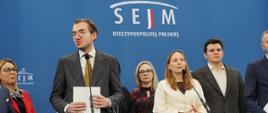
The Sejm has started work on the draft act on the SDF
21.11.2025
Investment in buildings where Poles will find shelter in the event of emergency, but also investment in the protection of critical infrastructure, such as railway lines - all of this will be possible following the enactment of the Act on the Security and Defence Fund (SDF). Today, the first reading of the SDF Act has taken place in the Sejm. Almost every tenth zloty from the NRP is allocated to this fund, the Minister of Development Funds and Regional Policy, Katarzyna Pełczyńska-Nałęcz said.

Poland is a pioneer in the European Union – we were the only country to separate money from the NRP to strengthen the country's security and defence and our preparedness for crisis situations. Approximately PLN 22.5 billion (EUR 5.3 billion) will be allocated. We will invest them in the development of protective buildings and civil protection infrastructure, the construction and modernisation of dual-use infrastructure, cyber security, the production capacity of Polish industry and support for research and development.
In order to make Poland more resilient and able to defend itself better against enemies who are in the Kremlin, in Moscow, a Security and Defence Fund is set up. Almost every tenth zloty from the NRP is allocated to this fund. We are the only country in the European Union to make such an innovative change in the NRP. We will use the funds from the SDF for civil protection and local government investment for civil protection, capital contributions to Polish companies for Polish innovative military technologies, protection of critical infrastructure, e.g. purchase of a drone monitoring system or neutralisation of hostile drones
– the Minister of Development Funds and Regional Policy, Katarzyna Pełczyńska-Nałęcz said at a press conference at the Sejm.
The Act on the Security and Defence Fund is also a very important law in terms of development. Beneficiaries of the fund include Polish armament companies which create jobs in smaller towns. Recapitalising these companies, increasing the number of jobs and production in their plants is the implementation of sustainable development and care for smaller centres, so that the quality of life in them is comparable to that in the largest agglomerations of our country
– Jan Szyszko, the Deputy Minister of Development Funds and Regional Policy said when presenting the draft SDF Act to the Sejm.
The Deputy Minister stressed that the SDF funds would be the first European money to be allocated to Poland for security, even before we receive funds from the Security Action for Europe (SAFE).
Where did the idea of the SDF come from?
The draft act, with the full name: “Act on special rules for the implementation of tasks related to security and defence investments carried out under the National Recovery and Resilience Plan” was prepared by the Ministry of Development Funds and Regional Policy. At the end of October, the draft was approved by the Council of Ministers.
The draft is a response to Russia's military invasion in Ukraine and the resulting geopolitical destabilisation in Europe and worldwide. For several years, surveys have shown that strengthening of the security of the State and its citizens are among the most important expectations of Polish women and men. This is a pan-European trend, with a November European Parliament poll showing that for 34 per cent of EU residents defence and security should be priorities for parliamentary action.
Four priorities of the SDF
Money from the Security and Defence Fund will be allocated for defence, shelter construction and new jobs in defence and security companies. The draft provides funding for four priorities:
- development of protective buildings and civil protection infrastructure – in this component, more than PLN 9.5 billion will be allocated for the construction of shelters, shelter sites, wells, water intakes and local wells, telecommunications infrastructure related to crisis management;
- construction and modernisation of dual-use infrastructure – approximately PLN 6.26 billion for the construction, modernisation of roads, bridges and tunnels owned by local authorities and railway infrastructure;
- investment in cyber security – approximately PLN 2.46 billion to increase the security and reliability of digital infrastructure that collects data and supports the management of our environment (water intakes, sewage systems, public transport, energy and fuel networks);
- modern industry – approximately PLN 4 billion to increase production in the Polish arms sector and create new jobs in the regions; support for, inter alia, the construction and modernisation of infrastructure, the purchase of software and IT services; machinery and equipment useful in crisis situations; machinery and equipment necessary for operations, particularly in industrial research and development.
The SDF will support the strengthening of production capacities in companies through the modernisation of their technological facilities, the digitalisation of processes and the expansion of production capacity. The support for companies located outside the major agglomerations will be particularly important serving better development of small and medium-sized towns.
The Fund will also strengthen the development of start-ups operating in security-related fields (seed and venture capital investments). In this way, it will also stimulate innovation and increase the competitiveness of the Polish defence industry at the national and international level.
SDF funding
The new regulations stipulate that Bank Gospodarstwa Krajowego (BGK) will establish the so-called special purpose vehicle (SPV) to finance investment in defence and security. BGK will be the sole owner of the SPV.
The objectives of the SDF will be funded through loans and equity investment. The loans will be spread over a number of years and will be interest-free (for local authorities) or at a rate of 0.5 per cent (for municipal companies). Partial remission of a loan will be possible. Maximum preferential loan parameters will be offered to companies, as permitted by the requirements of state aid rules for companies.
More than half of the SDF funds may be allocated to local governments for the construction of shelters. It will be possible to use them to subsidise both the construction and the modernisation of protective structures located in existing and newly constructed buildings managed by LGUs.
SDF Steering Committee
The investment priorities of the Fund will be determined by the Steering Committee. It will comprise the Minister of Development Funds and Regional Policy, the Minister of National Defence, the Minister of the Interior and Administration, the Minister of Finance and Economy.
The adoption of the SDF investment strategy which will set out the priorities, the operational framework and the allocation rules for future calls for proposals is scheduled until the end of 2025. The launch of the first calls for proposals will commence in the second half of 2026.
The Fund resources will also be available for use after 2026, i.e. after the National Recovery and Resilience Plan will be settled.