2026 will be a year of acceleration
18.02.2026
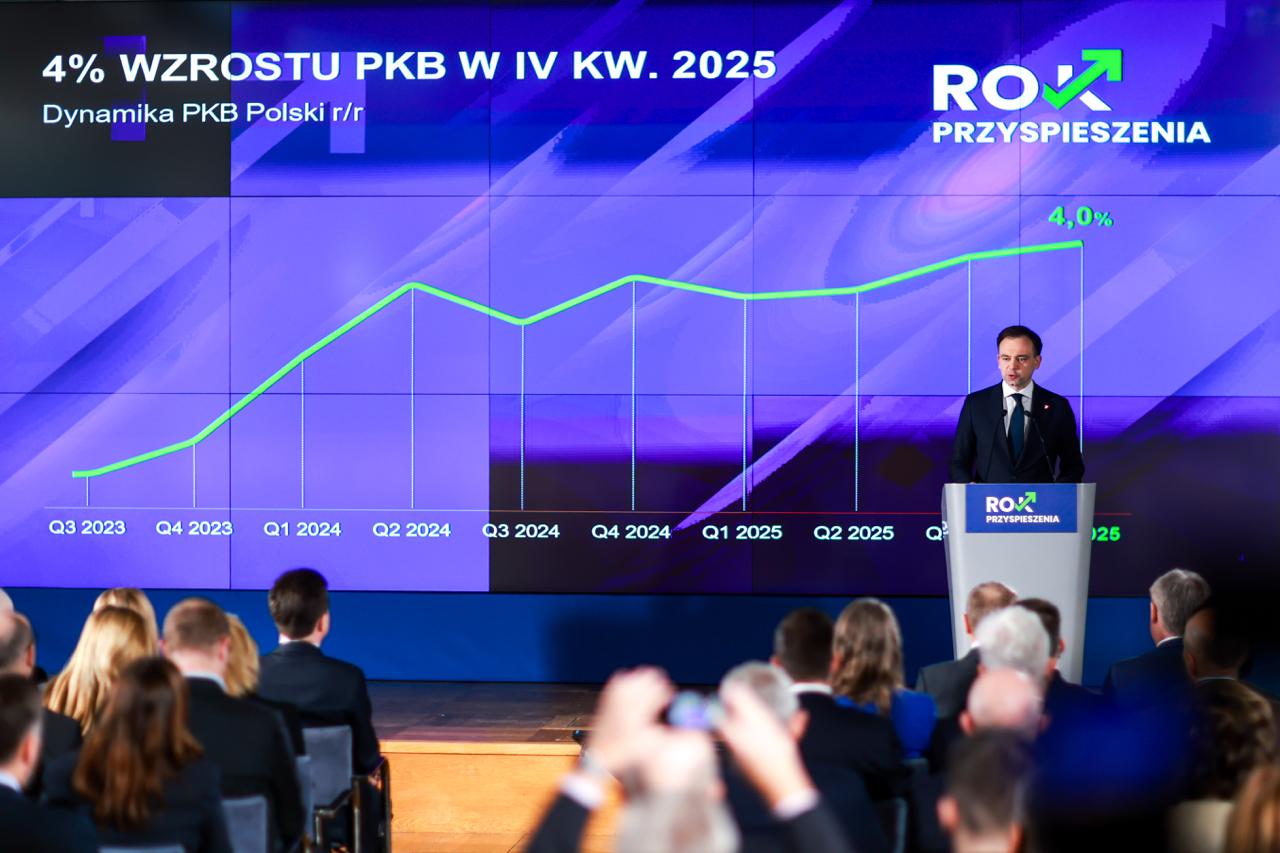
Poland is now the undisputed leader in economic growth in Europe. At the headquarters of the Warsaw Stock Exchange, Prime Minister Donald Tusk and Minister of Finance and Economy Andrzej Domański declared 2026 a year of acceleration. 'A year ago, I said that 2025 would be a breakthrough year for the Polish economy, and we succeeded. But 2026 will be a year of turbocharged acceleration,' the Prime Minister announced. In difficult geopolitical times, our country has become an oasis of stability and growth. We have joined the ranks of the world's 20 largest economies, we have strong GDP growth, record-low inflation, a strong złoty and the second-lowest unemployment rate in Europe. Poland is becoming the best place to live in Europe.

The impressive strength of the Polish economy
Last year, Prime Minister Donald Tusk announced at the Warsaw Stock Exchange that 2025 would be a year of investment and breakthrough for Poland. The economic data confirm this. According to Statistics Poland, GDP grew by 3.6% last year.
This happened despite the circumstances, geostrategic uncertainty and the dramatic events connected with the Russian-Ukrainian war. Despite all of this, Poland has become an oasis of stability and growth
– emphasised the Prime Minister.
Poland’s GDP performance in 2025 was significantly stronger than that of the European Union’s largest economies – last year, Germany recorded economic growth of 0.3%, while France grew by 0.9%.
I firmly believe that this is not our final word and that Poland will also demonstrate unprecedented acceleration in 2026. We want to impress the world even more with our undisputed growth leadership in Europe
– the Prime Minister announced.
The Polish economy is accelerating significantly
Minister of Finance and Economy Andrzej Domański emphasised that Poland is now one of the main engines of growth in the European Union and that its contribution to the growth of the EU economy as a whole will reach a record level in 2026.
Poland has returned to the path of development and regained its place in the economic premier league. The year 2026 will be the Year of Acceleration. Poland is already an engine of EU growth. Our contribution to the growth of the EU economy in 2026 will be greater than that of Germany or France. This year, the growth rate of investment will be at least twice as high as in 2025. Growth of 10% is achievable. Investment will be the engine driving the Polish economy in 2026
– said Minister of Finance and Economy Andrzej Domański.
In 2026, investment is expected to be a key pillar of economic growth. Its growth rate could reach as much as 10–11%, clearly exceeding the pace recorded in previous years.
There are specific engines behind our economic growth. For many quarters, GDP growth was driven primarily by consumption, but the fourth quarter of 2025 brought a real breakthrough. In December, industrial production rose by 7%, while Polish exports accelerated to a growth rate of nearly 10%. The economy is working for citizens. Real wages, adjusted for inflation, are rising at the fastest pace of the 21st century
– Minister Domański noted.
Record funding from the state budget is to be allocated, among other things, to defence, road and rail infrastructure, ports and the energy transition. Investment will also cover nuclear energy, offshore wind energy, space technologies, energy storage facilities and systems enhancing energy security.
Minister Domański also pointed to an ambitious goal for the next few years – catching up with the United Kingdom in terms of GDP per capita.
In five or six years, we will catch up with the United Kingdom in per capita terms, adjusted for price levels. This is the indicator in which we overtook Japan last year. Something Lech Wałęsa spoke about 40 years ago and which seemed impossible became a reality in 2025. Today, the whole world looks at Poland with admiration
– said Minister Domański.
As he emphasised, Poland is steadily closing the gap with the world’s richest economies, with investment, exports and the building of technological sovereignty forming the foundation of this process.