Poland reached the stars. Dr. Sławosz Uznański-Wiśniewski returned to the country
24.07.2025
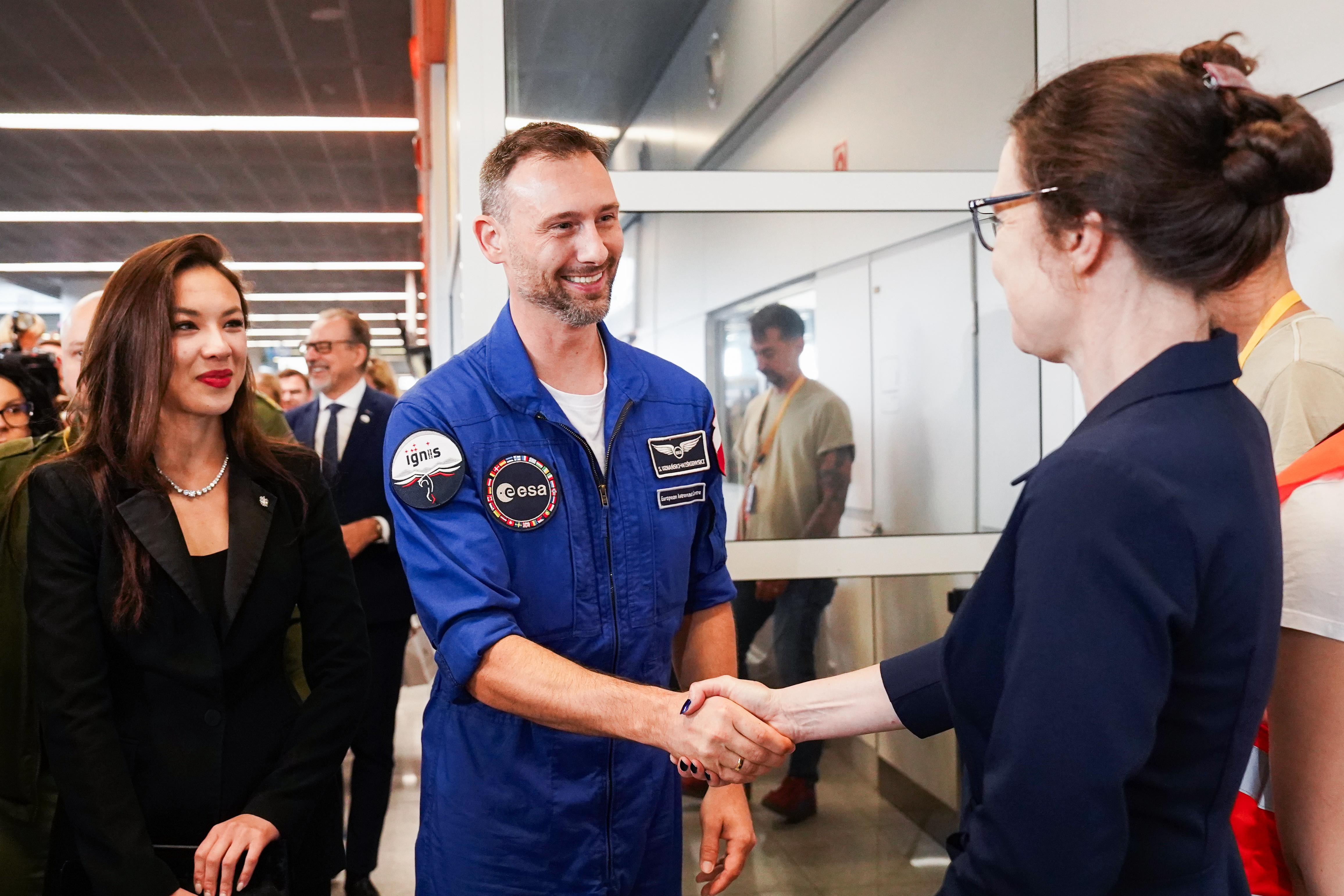
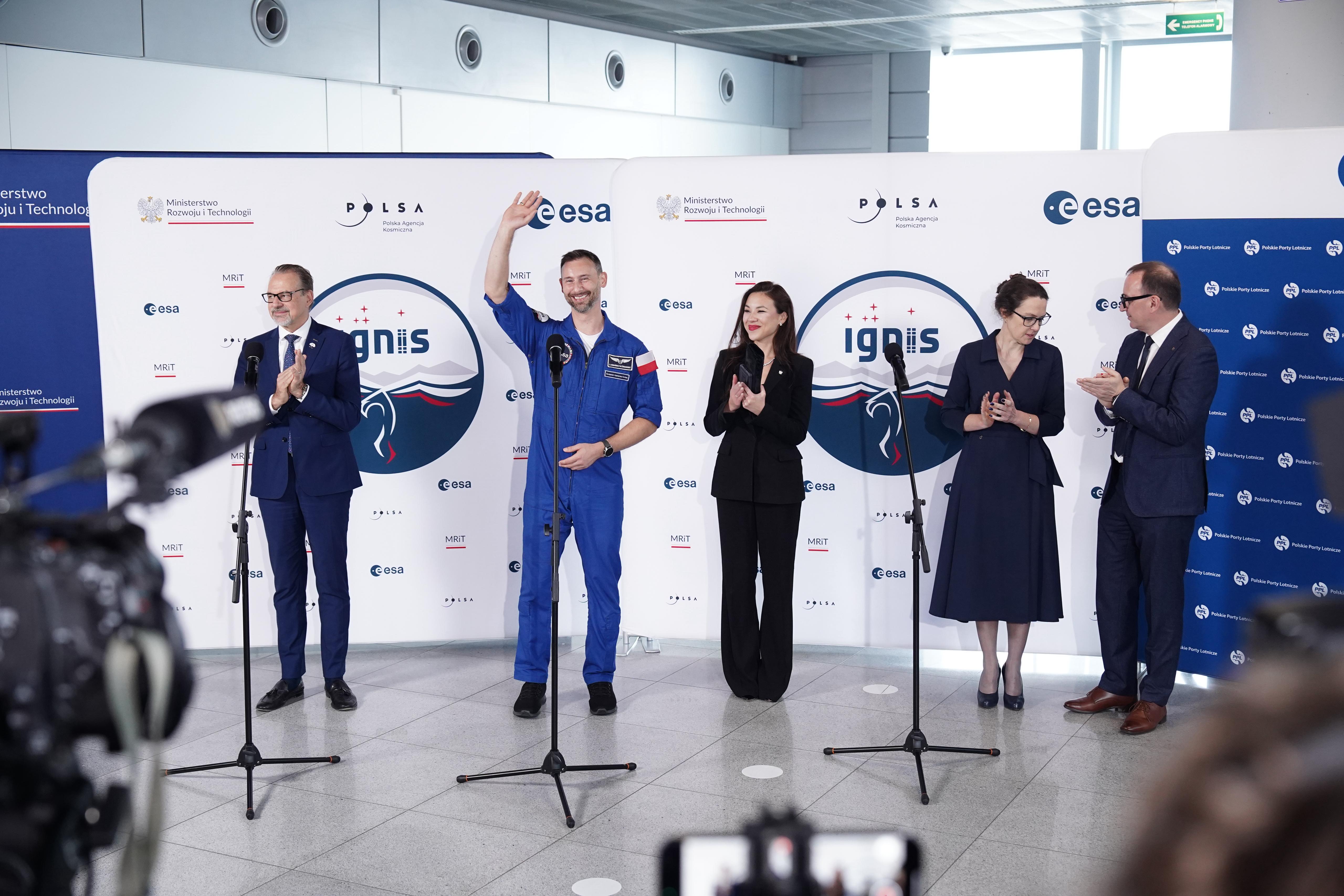
Upon successful accomplishment of the first national technological and scientific mission at ISS, the Polish astronaut returned today to the country. At the Warsaw Chopin Airport, he was welcomed by the President of POLSA, crowds of space, science and technology enthusiasts and the journalists. The first Pole in space since decades accomplished his 20-day long mission at the International Space Station. Poland gains prestige, new competences and real participation in manned space exploration.

I am deeply honoured to welcome you to the Polish land on behalf of the Polish Space Agency and the representation of the Government and express my admiration that everything has succeeded and that you have represented us so boldly at the International Space Station. This is the new stage for the Polish space sector. We hope that you will be an ambassador of our technologies
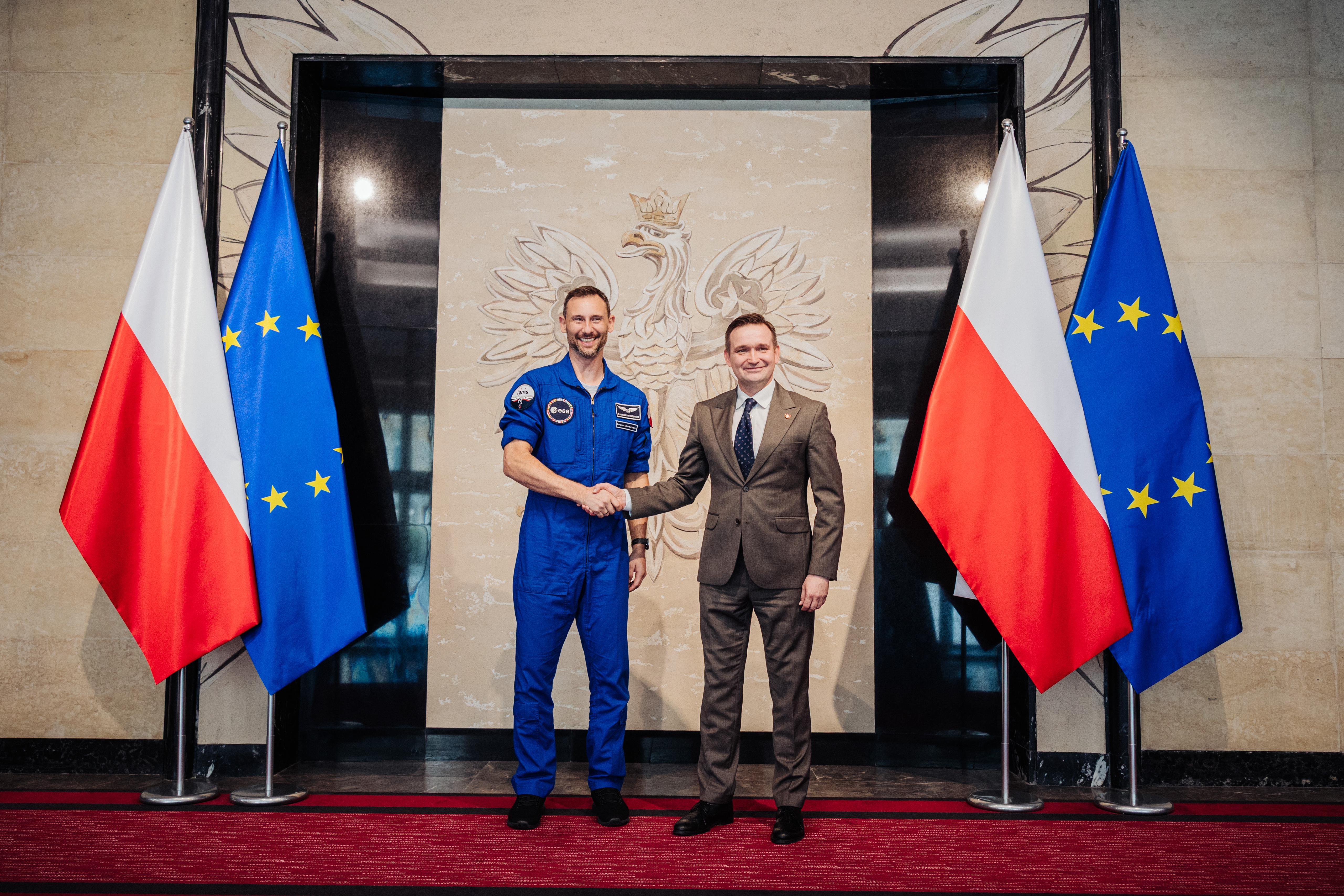
- stated the President of the Polish Space Agency, Marta Ewa Wachowicz. Earlier on, the Polish astronaut was welcomed at the military section of the airport by Deputy Prime Minister, Minister of National Defence, Władysław Kosiniak-Kamysz. In the seat of the ministry, Sławosz Uznański-Wiśniewski was welcomed by Deputy Minister Michał Jaros.
The IGNIS mission was launched from the John F. Kennedy Space Center, Florida, on 25 June 2025. For nearly three weeks, Dr. Sławosz Uznański-Wiśniewski has stayed 400 km above the Earth, orbiting around the planet 320 times with the speed of 28,000 km/h. In this time, he carried out 13 scientific and technological experiments prepared in Poland and took part in research conducted by ESA and the Hungarian and Indian partners.
The astronaut spent 105 hours for research, educational and communicational works. He accomplished the established mission goals in 100 percent and even performed some additional tasks. After 20 days in the orbit, he returned to Earth and today – after a short convalescence – to the country.
I am extremely proud of the opportunity to represent all Poles in space. Each day of carrying the Polish flag in the orbit was a great honour to me. I hope that I managed to somehow take you there with me. This is actually just the beginning. These are our ambitions we can demonstrate today. I hope that in 5 years the Polish space sector will be the leader of space technologies in Europe
- stressed Dr. Sławosz Uznański-Wiśniewski.
EUR 65 million from the Polish budget. Investment in the economy of the future
The cost of IGNIS mission was entirely covered by MEDT and amounted to EUR 65 million. This is the strategic investment – not only in science and education, but also in development of the national high technology sector.
A part of the IGNIS mission was testing the technologies, which may be applicable in medicine, defence, material and biotechnology sectors. The examples include:
- state-of-the-art nanomaterials,
- bioprocesses in microgravity conditions,
- immune systems in zero gravity,
- artificial intelligence in biological process analysis,
- radiation resistant electronics.
The test results will underlie further development of the R&D projects and supporting the scientific and industrial partnerships.
Today, there are approx. 500 operators in Poland involved in space technologies. The sector employs even up to 15 thousand of people, while the value of contracts of the Polish companies with ESA exceeds EUR 370 million.
The Polish companies specialise among others in: Earth observation and satellite data analytics, satellite communication and navigation systems, AI and space security solutions, construction and integration of nanosatellites.
The economic effect of the mission: increasing the opportunities for commercialisation of research results, building competitive advantages, development of new sectors (space-tech, satellite data analytics, medical technologies), incentive for development of start-ups and SMEs in the space sector.
International dimension of IGNIS: Poland gained prestige and real participation in manned space exploration, strengthened its position as a reliable partner of ESA and space agencies, confirmed the competences of domestic companies in global context – Polish “flight heritage”.
Education and inspiration – “Poland reaches the stars”
The IGNIS mission had also a unique educational and social dimension. Thanks to interactive transmissions from the orbit, thousands of students around the country had the opportunity to meet live the Polish astronaut and get know how the work of a scientist in space looks like.
The all-Poland cycle of educational events “IGNIS – Poland reaches the stars” will be kicked off in autumn. During the cycle, Dr. Uznański-Wiśniewski will meet with pupils and students in the entire country.
Purpose of educational activities
- building social capital related to science and technology,
- promoting the career paths in the advanced technology sectors,
- inspiring young people to study at the engineering, exact and space sciences faculties.
The IGNIS mission is the investment in competences of the young generation, development of science-based economy and building the position of Poland as the partner of the new generation of the European and international projects. Success of the IGNIS mission is the starting point for subsequent activities in the area of science, technology and space industry.