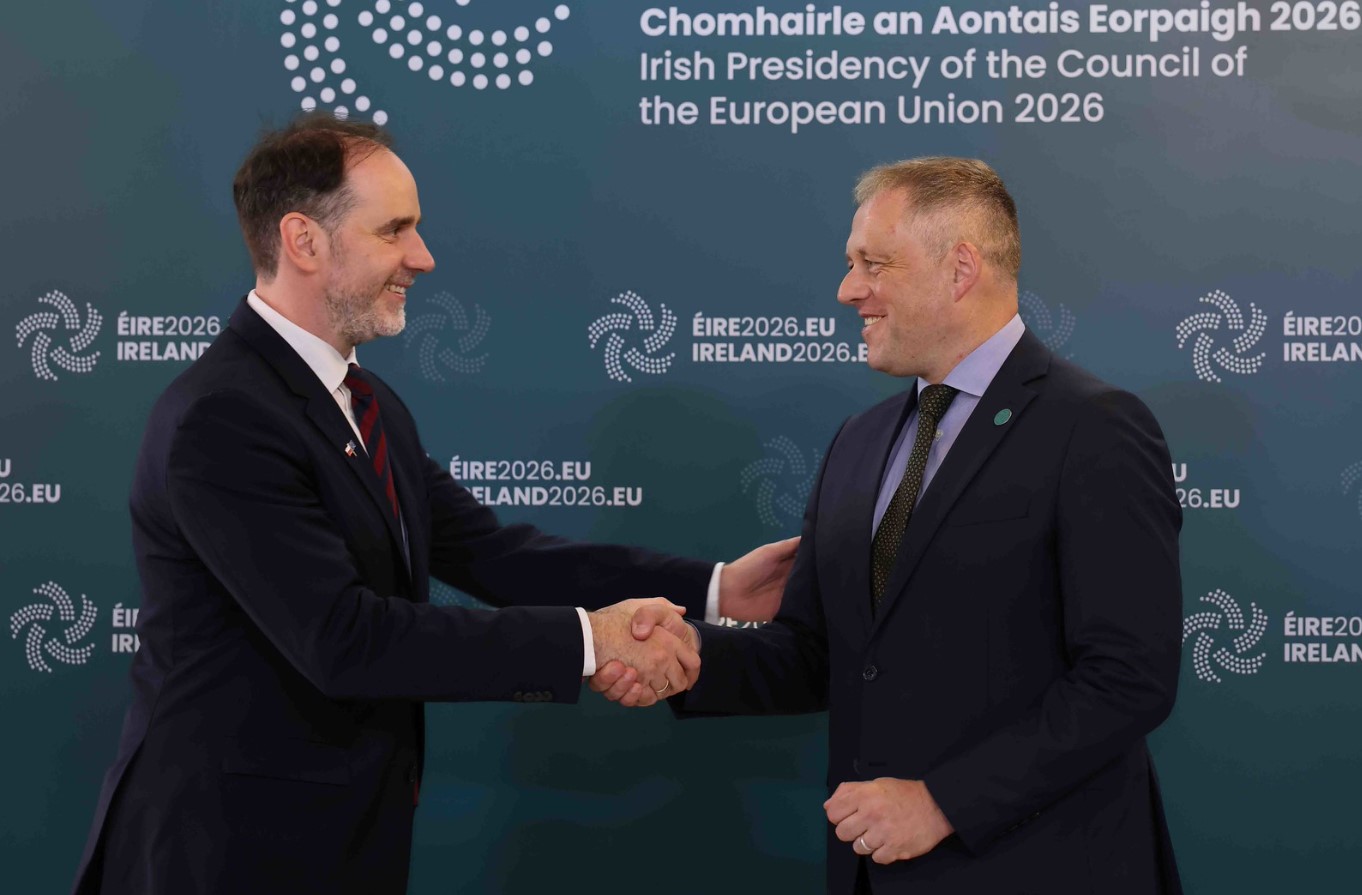
Secretary of State Ignacy Niemczycki takes part in informal General Affairs Council meeting in Dublin
04.09.2026
On 3-4 September, Deputy Minister Ignacy Niemczycki took part in an informal General Affairs Council meeting in Dublin, held as part of the Irish Presidency of the Council of the European Union. The ministers spoke about the European Union's budget for 2028-2034, EU enlargement, and the European Democracy Shield.

While discussing the budget, the ministers were joined by the European Parliament’s co-rapporteurs. The participants considered how the next EU budget can boost competitiveness, security, and defence.
Deputy Minister Ignacy Niemczycki highlighted the roles of the cohesion policy and the Common Agricultural Policy in the European Union’s response to contemporary challenges.
Investments funded under the cohesion policy also help address new security and defence challenges, for example by means of dual-use investments. Competitiveness and cohesion are two sides of the same coin and should not be contrasted with one another. It is the cohesion policy that contributed to the growth of the Polish economy and in doing so boosted European competitiveness
emphasised the MFA deputy head Ignacy Niemczycki.
The secretary of state also supported Europe-wide access to those parts of the EU’s future budget whose funding is set to increase significantly, in particular to the Horizon Europe programme and the European Competitiveness Fund.
In a conversation with countries seeking to join the European Union, Deputy Minister Niemczycki presented a common position of the Weimar Triangle states.
Enlargement is a geopolitical necessity—it will strengthen our security and unite our continent. So far, each time enlargement has brought benefits to both candidate countries and the European Union and its member states. At the same time, the speed of the accession process depends on the political will and efforts of the candidate states in fulfilling the membership criteria. The process continues to be based on tangible progress
stressed Deputy Minister Niemczycki.
The ministers of Poland, France, and Germany supported initiatives which are gradually bringing the candidate states closer to the EU. They identified three areas of particular importance: a wider participation of candidate countries in EU programmes that benefit their citizens, knowledge sharing, and strengthening resilience to disinformation.
They also pointed out that candidate countries must go on with reforms, in particular in fundamental areas such as the rule of law, fight against corruption, and independence of the judiciary.
The ministers for European affairs also addressed the subject of future accession treaties. Secretary of State Ignacy Niemczycki reaffirmed Poland’s readiness to engage in talks on safety mechanisms with respect to the protection of the rule of law, the integrity the single market, and the principles of fair competition.