A Safer Poland in a Changing Climate - 9 Measures for Water Management and National Resilience
25.06.2026
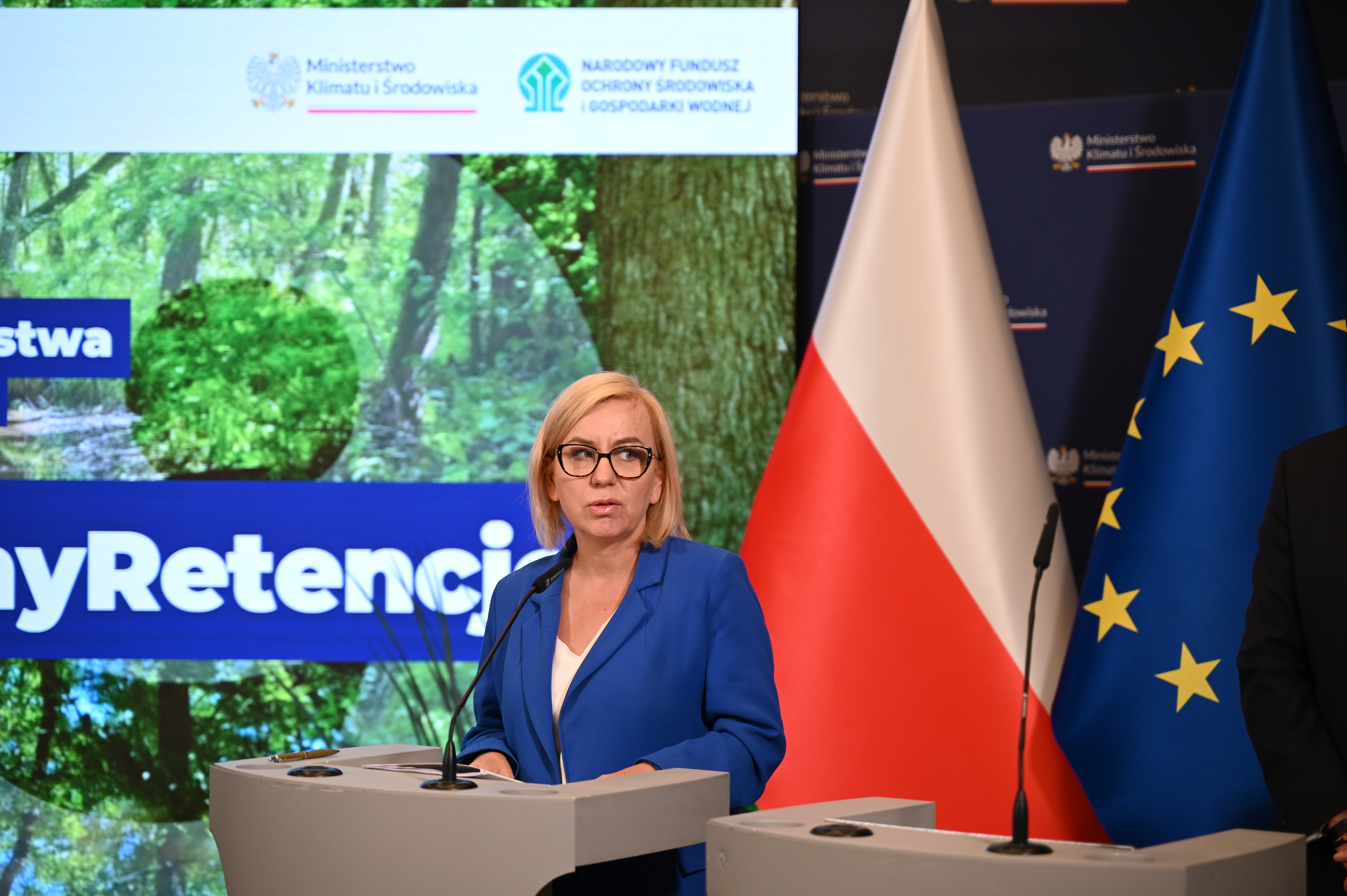
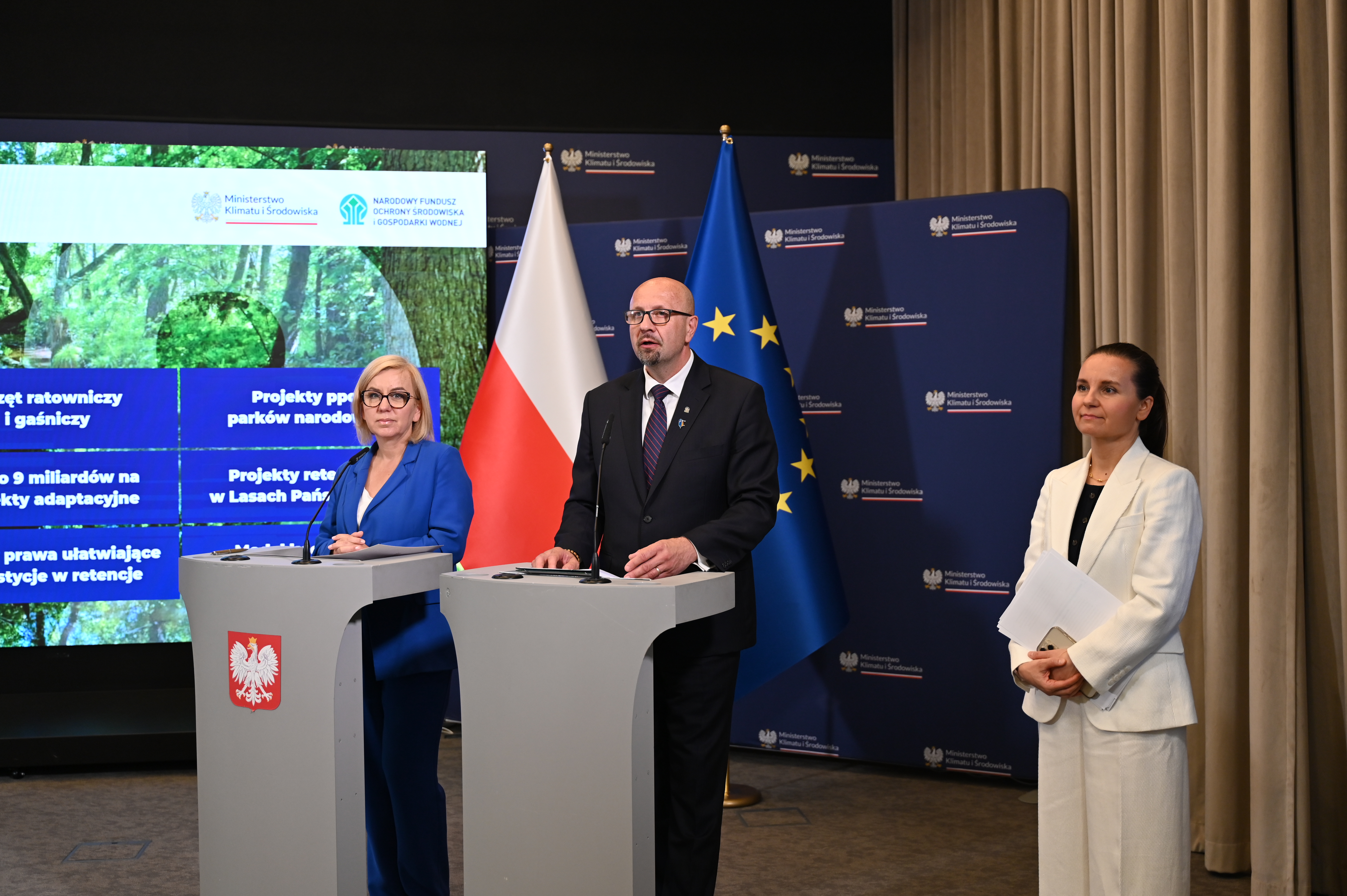
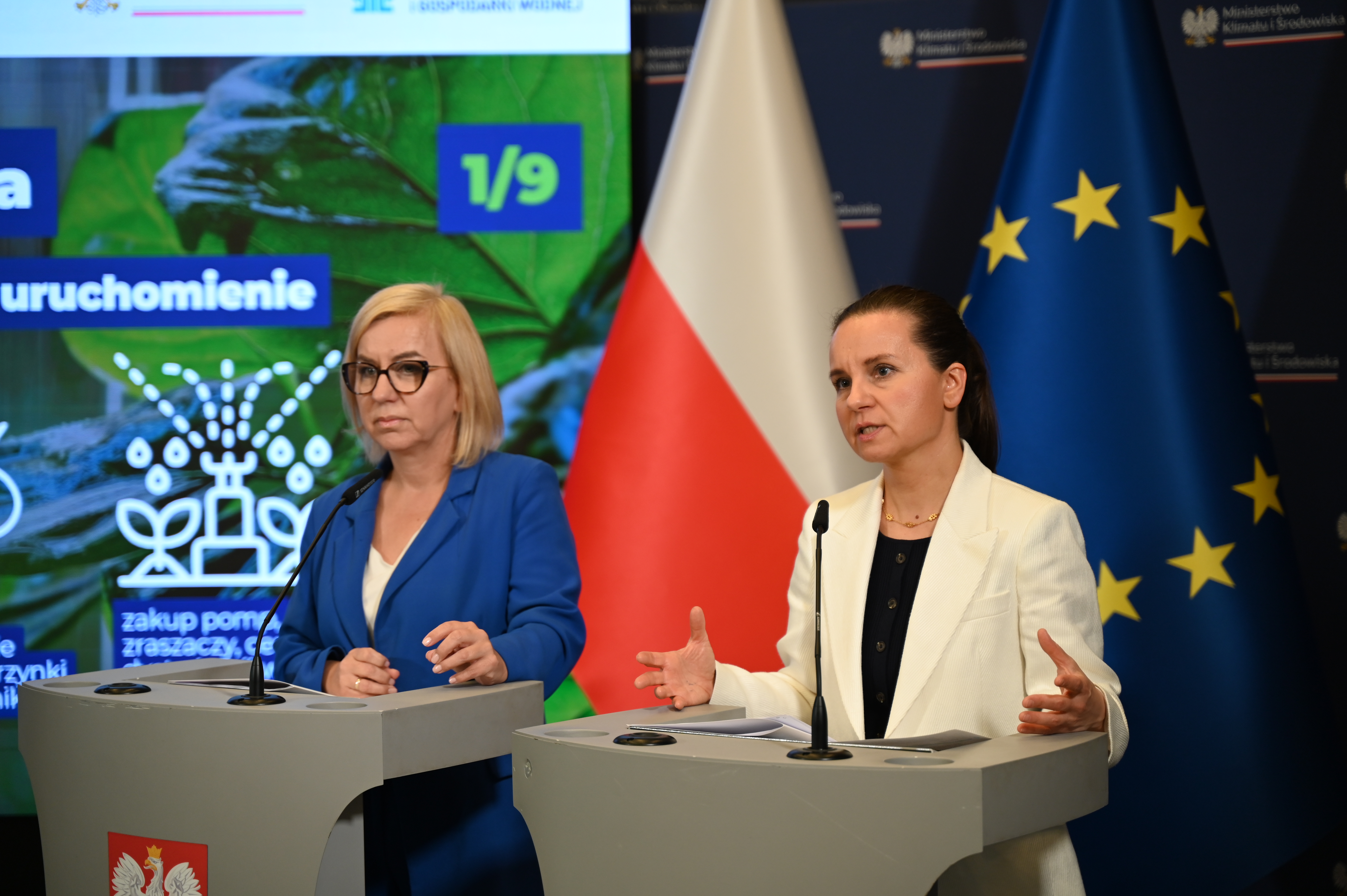
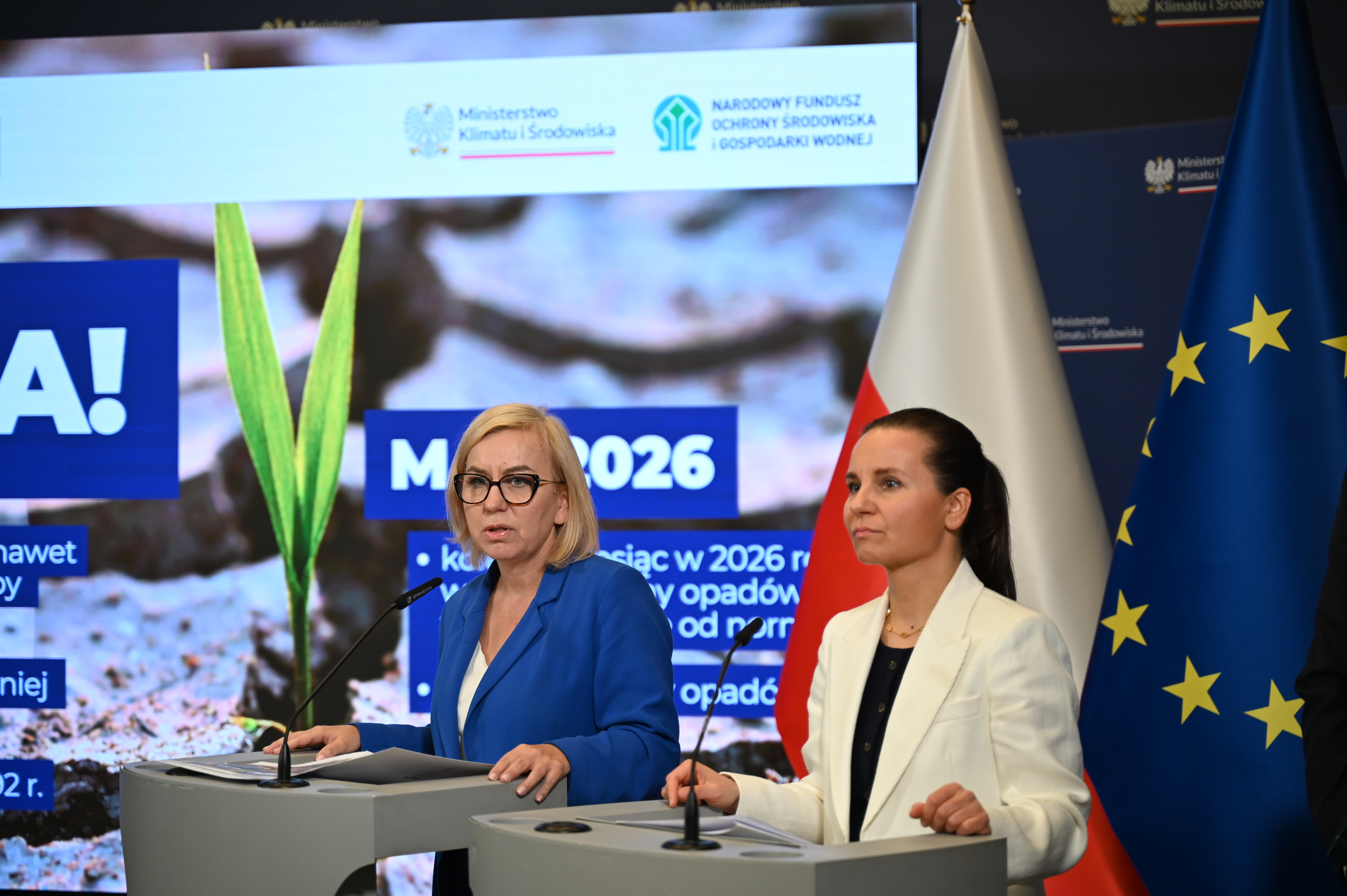
Poland needs decisive and effective measures to protect it from the effects of fires, droughts, flooding and other extreme weather events. In response to these challenges, the Ministry of Climate and Environment is implementing a package of nine initiatives to strengthen the country's climate security. They form a coherent strategy of reforms and investments, increasing Poland's resilience to climate change whilst supporting the development of a modern and sustainable water management system. One of the elements is the call for applications under the 'Micro-retention' programme, launched on 22 June, in which owners of single-family houses can receive up to PLN 8,000 in funding for the collection and use of rainwater. The Minister of Climate and Environment, Paulina Hennig-Kloska, and Deputy Minister Urszula Zielińska discussed the details during a press conference held on 24 June 2026 in Warsaw.

Highlights
- The Ministry of Climate and Environment is implementing a package of nine measures to strengthen Poland’s climate resilience.
- Under the Ministry's programmes, European Funds for Infrastructure, Climate and the Environment and European Funds for Eastern Poland, nearly PLN 9 billion has been allocated to investments linked to climate change adaptation, such as enhancing the safety of residents and increasing the resilience of infrastructure to extreme weather events.
- Since 2024, a total of 199 contracts have been signed in the area of climate change adaptation, with EU funding amounting to PLN 4.4 billion.
- Applications for the ‘Micro-retention’ programme have been open since 22 June. Participants can receive up to PLN 8,000 for systems to collect and use rainwater.
- The Ministry is developing water retention measures in towns, forests and national parks, and supporting fire prevention activities. New regulations, strategies and inter-agency cooperation are designed to better prepare Poland for the effects of climate change.
Climate change is having an increasingly noticeable impact on our daily lives. We are increasingly facing periods of drought, torrential rain, localised flooding and a growing risk of fire. The data show that Europe is the fastest-warming continent in the world, and recent years have been among the driest in decades. This is precisely why the Ministry of Climate and Environment is consistently stepping up its efforts to ensure the country’s climate security.
This year’s spring served as a serious warning for Poland. In many regions, the moisture content of the forest litter has fallen below 10%, and rainfall levels have been significantly below the long-term average. We have therefore consolidated all our initiatives into nine measures aimed at ensuring Poland’s climate resilience. These include strategies and legislative changes, new models of inter-institutional cooperation, investment in flood retention and fire safety, and programmes to support local authorities and residents. We want to show not only how we diagnose the problem, but above all how we build the country’s resilience to drought and the effects of climate change
– said Minister of Climate and Environment Paulina Hennig-Kloska.
The ‘Micro-retention’ programme has been launched – up to PLN 8,000 for rainwater harvesting
One of the latest initiatives is the ‘Micro-retention’ programme, for which applications opened on 22 June 2026. The programme is aimed at owners, co-owners and leaseholders of single-family houses. It is possible to receive a refund of up to 90% of the eligible investment costs, up to a maximum of PLN 8,000. The programme’s budget amounts to PLN 173 million and comes from the European Funds for Infrastructure, Climate and the Environment (FEnIKS).
The funding may be used, for example, for:
- collecting rainwater from roofs, pavements and driveways,
- storing water in tanks,
- retaining water in the ground,
- installations enabling the use of collected water, e.g. for watering the garden.
Rainwater retention helps to mitigate the effects of drought, reduces the risk of flooding during heavy rainfall and helps to lower water bills. Applications are accepted by voivodship environmental protection and water management funds throughout Poland. They can only be submitted electronically.
One of the most important elements of our work is the development of water retention. That is why we have launched programmes to support its restoration. This week, we started a programme to support micro-retention in residential areas, encouraging residents to collect rainwater and retain it where it falls. There is no single solution to combating drought – we need measures ranging from the household level to large-scale projects implemented by the state and local authorities, such as the Nature Component of the “East Shield” programme
– said Minister of Climate and Environment Paulina Hennig-Kloska.
We have launched a micro-retention programme for households, because every drop of water saved counts these days. Up to PLN 8,000 in funding, covering up to 90% of the investment costs, can be allocated to rainwater tanks, soakaways, infiltration systems or rainwater storage. This is our response to the challenges we are already seeing across Poland. Concrete-covered cities are increasingly unable to cope with heavy rainfall, and residents are facing flash flooding and waterlogging. That is why we are investing in on-site retention, green-and-blue infrastructure and the removal of impervious surfaces. These are no longer merely environmental measures – they are investments in the safety and resilience of our towns and local communities in the face of climate change
– added Urszula Zielińska, Deputy Minister of Climate and Environment.
In the face of rapid climate change, it is vital to realise just how precious every drop of water is. Building the resilience of the country and its cities requires significant financial investment, which is why the National Fund for Environmental Protection and Water Management (NFEP&WM) consistently supports both the implementation of large-scale infrastructure projects and decentralised water retention. We are pleasantly surprised by the interest in the micro-retention programme – 7,000 applications have already been registered in the system, of which 1,400 have been submitted. This demonstrates the high level of interest in the programme
– stressed Robert Gajda, Deputy President of the Management Board of the NFEP&WM.
9 measures for climate security
The package of measures implemented by the Ministry of Climate and Environment includes:
1. Support for on-site water retention
The new ‘Micro-retention’ programme helps residents retain rainwater on their own properties and use it in their daily lives.
2. Support for firefighters and the State Forests
The Ministry of Climate and Environment is funding the purchase of modern rescue and fire-fighting equipment to improve the effectiveness of operations during fires and other emergencies.
3. Fire safety in national parks
The first-ever comprehensive fire safety programme for national parks is being developed, with a particular focus on the areas most at risk.
4. Fight against ‘betonoza’ (from beton (‘concrete’) + -oza)
The Ministry of Climate and Environment supports the creation of green spaces, the removal of concrete from cities, the development of pocket parks, wildflower meadows and other nature-based solutions.
5. Investments in adaptation to climate change worth nearly PLN 9 billion
The funds are earmarked for local authority projects designed to protect against the effects of droughts, flash floods, floods and other extreme weather events.
6. Water resource management plans and water retention projects in forests
Projects are being developed for small-scale water retention, wetland conservation and water resource management in forest areas.
7. Strategic documents
Key documents are being drawn up to set out the direction for building Poland’s climate resilience, including the National Adaptation Strategy, the National Plan for the Restoration of Natural Resources and the National Forest Programme.
8. Changes to the law
The new regulations simplify the implementation of projects related to water retention and adaptation to climate change, for both residents and local authorities. These include:
- an amendment to the Environmental Protection Act, consisting in the Ministry of Climate and Environment’s implementation of a standard for urban adaptation plans, which must be based on detailed analyses of climate change and include carefully planned adaptation projects,
- the issuance of a regulation setting out the detailed scope of the report on monitoring the implementation of climate change adaptation measures,
- the preparation of a draft bill to facilitate the implementation of investments in green water retention in towns and cities, as well as landscape and riverbed water retention,
- support from the Ministry of Economic Development and Technology in simplifying regulations that local authorities and residents have complained about – the amended legislation will facilitate the construction of rainwater storage tanks (amendment to the Construction Law) and accelerate the implementation of green retention (amendment to the regulation on the technical conditions to be met by buildings and their location).
9. A new model of cooperation within catchment areas
The Ministry of Climate and Environment is developing a model of cooperation within catchment areas, integrating the activities of local authorities, public institutions, the scientific community and water managers to better coordinate retention projects. The aim is to create a coherent planning system that will enable more effective use of funds and increase the effectiveness of measures across entire catchment areas.
Flash floods, forest fires and increasingly frequent heatwaves show that climate security is becoming one of the most important challenges facing the state. That is why, at the Ministry of Climate and Environment, we are investing in flood retention, fire protection, urban adaptation and the restoration of natural resources. Building resilience to climate crises is just as important today as preparing the country for other threats
– added Urszula Zielińska, Deputy Minister of Climate and Environment.
Strengthening Poland’s climate resilience
Since 2024, 199 major contracts have already been signed in the area of adaptation to climate change, with a total value of PLN 4.4 billion from EU funding. The projects include, amongst other things, the development of blue-green infrastructure in towns and cities, the restoration of rivers and wetlands, flood protection and improvements to water safety for residents. At the same time, measures are being implemented to support forest conservation, the development of water retention in forested areas and the restoration of ecologically valuable aquatic ecosystems.
The aim of all the measures implemented by the Ministry of Climate and Environment is to increase Poland’s resilience to the effects of climate change. This means better protection against droughts, flooding and fires, greater safety for residents, and more effective water resource management.