Pilot project for Oder River desalination technology - recruitment begins
16.03.2026
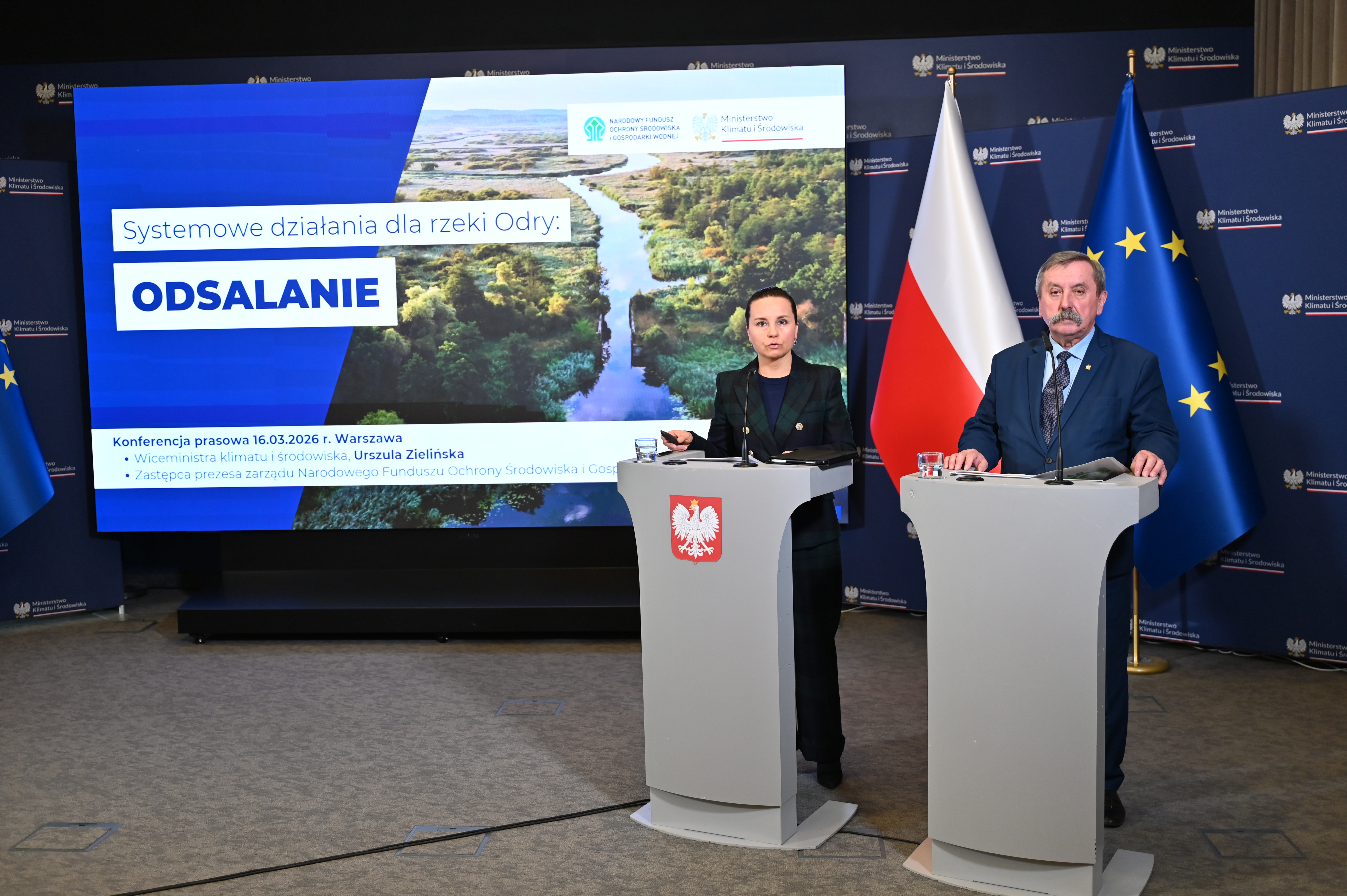
The Ministry of Climate and Environment is launching a recruitment drive for a pilot project of innovative technologies to reduce the salinity of the Oder River. The call for proposals, organised by the National Fund for Environmental Protection and Water Management (NFOŚiGW), aims to support research into more energy-efficient methods of desalinating mine water and to test these methods under industrial conditions.

Highlights
- On March 16, 2026, the National Fund for Environmental Protection and Water Management (NFOŚiGW) will launch a call for proposals for a pilot scheme on innovative technologies for the desalination of mine water.
- The pilot project is to be carried out through an open call for technology proposals, in collaboration with mining companies.
- Solutions are being sought that are cheaper than traditional ones and can be implemented on a large scale.
Mine water desalination technologies are one of the biggest challenges for the Oder River. As part of the work carried out by the Inter-ministerial Team for the Oder River, two barriers were identified: the high costs of constructing and operating such facilities, and the disposal of by-products from the process (e.g. low-value mineral mixtures). To help resolve these issues, it was decided that innovative technologies needed to be found.
The pilot recruitment is carried out under the NFOŚiGW priority program: Reducing the nuisance caused by mineral extraction.
We are launching a pilot program to desalinate post-industrial waters that pollute the river on a daily basis. As part of this year’s call for proposals, we will allocate up to PLN 68 million to innovative technologies designed to reduce salinity – one of the key problems of the Oder River. This is the first step towards broad, systemic action and a complement to the intensive work conducted for over two years by the Inter-Ministerial Team for the Oder River
- said Urszula Zielińska, Deputy Minister for Climate and the Environment, during the conference launching the call for proposals.
Seeking after technology
Innovative solutions are sought that are not as energy-intensive as traditional desalination methods. This process consumes a great deal of energy, which results in high costs for mining operations. This is the main obstacle to this type of investment. It is essential that innovative technologies are tested in real-world conditions; therefore, a key requirement for participation is the inclusion of mining sites in the pilot scheme.
The programme is open to a wide range of beneficiaries – universities and research institutes of the Polish Academy of Sciences are eligible to apply.
What problem are we trying to solve?
Around 6,000 tonnes of salt are delivered to the Oder River every day, which is equivalent to 120 wagons of pure salt. High salinity is one of the reasons for the river’s poor ecological status. Environmental standards relating to salinity are exceeded along the entire length of the Oder River, in some cases by several times. The persistently high salinity of waters is one of the causes of the appearance of the "golden algae" in the Oder River – a saltwater algae that caused an ecological disaster in 2022 and continues to threaten ecosystems.
Areas of focus for the Ministry of Climate and Environment
The Ministry of Climate and Environment aims to improve the ecological status of the Oder River. To this end, the following are required:
- reduction of salinity – the Ministry of Climate and Environment has drawn up Phase I of the Mining Sector Investment Plan, aimed at reducing the salinity of the waters of the Oder River. This plan is scheduled for implementation by 2030. The first element of Phase I is the development of mine water retention during periods of low water levels, which will reduce the effect of pollutant accumulation and the occurrence of high salt concentrations in water.
- The second element is the piloting of innovative desalination technologies.
- Once the pilot results are obtained and additional analyses are completed, Stage II of the plan will be developed, including investments in desalination plants, which will further reduce water salinity in the Oder River basin.
- implementation of automatic water monitoring – in 2026, 10 probes will be installed on the Odra River (two of them are already operational). Ultimately, as part of the Environmental Protection Inspectorate’s remit, a nationwide warning system will be established;
- enhancing the resilience of ecosystems – increasing funding opportunities for local projects under the FEnIKS programme;
- strengthening the protective measures of Międzyodrze – a long-term protection program for this area is being prepared.
The application guidelines are available on the website of the National Fund for Environmental Protection and Water Management.