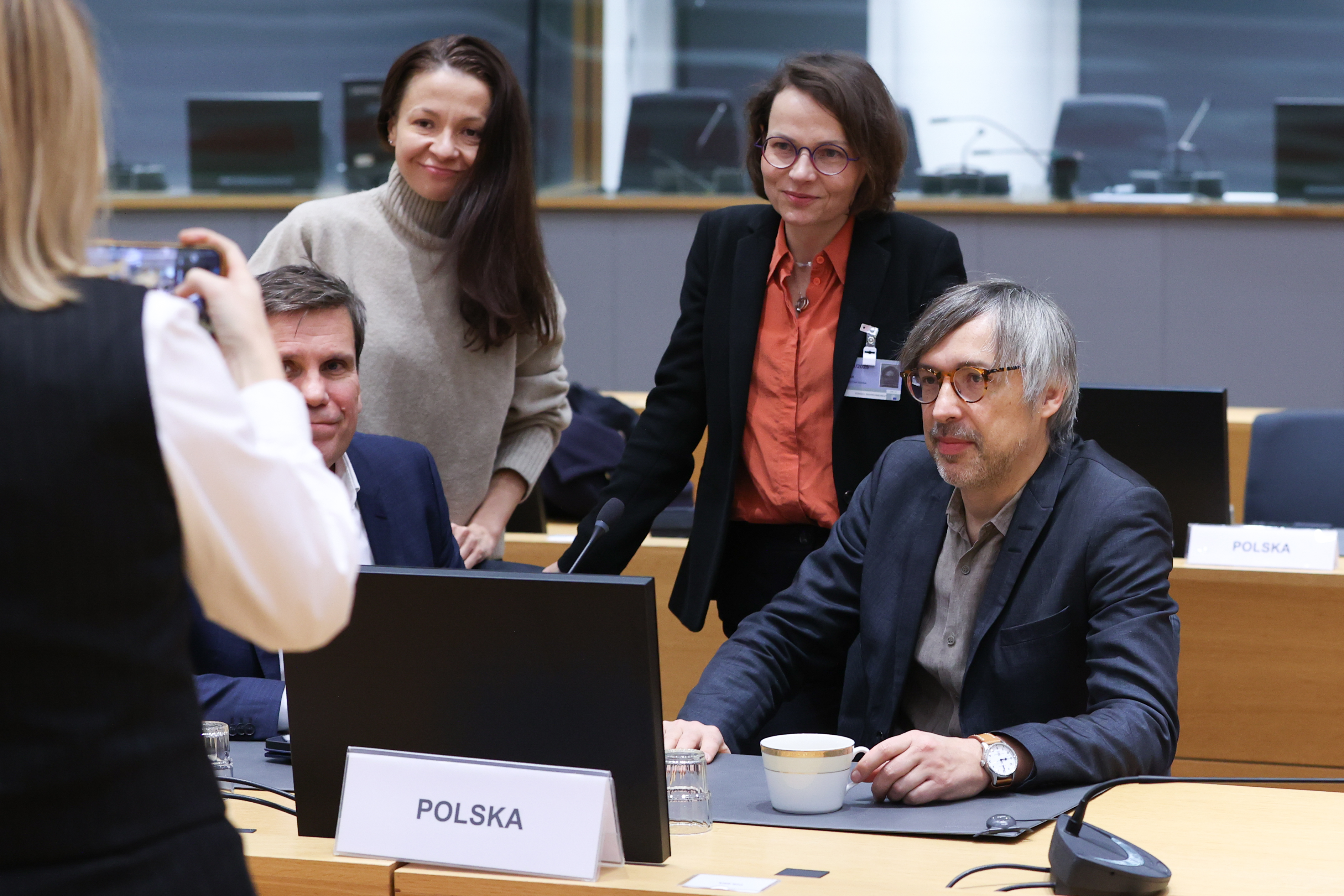
The Environment Council (ENVI) has agreed on a revision of the European Climate Law, ETS 2 delayed. Poland is effectively changing the way EU climate policy is shaped.
05.11.2025
During the meeting of the EU Environment Council, a new interim emission reduction target of 90% at EU level for 2040 was agreed. Poland has not supported this target, consistently emphasising that under the current economic and geopolitical conditions, such a target is impossible to achieve. We have also negotiated a postponement of the entry into force of ETS 2, and by the end of 2025, the Commission will present a proposal for a thorough revision of the ETS.

Highlights:
- During the EU Environment Council meeting, a new interim emission reduction target of 90% for 2040 was agreed.
- The package also includes a one-year delay in the entry into force of ETS 2, i.e. from 2028.
- The decision on the 2040 reduction target applies to the EU as a whole – this does not mean that each country will have to reduce its emissions by this amount. No specific targets have been set for individual Member States, including Poland.
- Poland has not supported this target, consistently emphasising that under the current economic and geopolitical conditions, such a target is impossible to achieve.
- At Poland's request, two strong review clauses were introduced, allowing the 2040 target to be changed. Poland has ensured that it can be adjusted to changing conditions.
- The new law contains two review clauses, which are safeguards protecting people and the economy.
- The first clause obliges the European Commission to review progress every two years.
- The second clause guarantees that in the event of rising energy prices, declining competitiveness, increased negative pressure on societies or macroeconomic difficulties, the EU will be allowed to revise the target and lower its level of ambition.
- Flexible targets and the possibility of revision mean security for people – if something goes wrong, we will be able to lower them. This structure protects against rising unemployment, energy prices and a deterioration in the competitiveness of the economy.
- We are effectively defending the defence industry – the new rules will help offset the negative impact of the EU's climate policy. Europe needs to build up its defence capabilities, and climate policy must not be an obstacle to this. \he Council's conclusions are the beginning of the process, which will now be negotiated with the European Parliament.
This is a historic change in EU climate policy. We are moving away from the paradigm of rigid climate targets towards an aspirational and flexible model that takes into account real economic and social conditions.
The agreements on the 2040 target are a real step towards changing the paradigm of EU climate policy. We have successfully persuaded our EU partners to postpone the entry into force of ETS 2 and to introduce a flexible target with review clauses. We are replacing rigid targets with a realistic and pragmatic approach. Climate policy should serve people and be built on European economies and European technologies. We are implementing such a climate policy in Poland and at the EU level
- said Minister Krzysztof Bolesta.
Poland's success in the ETS 2 case
The new law stipulates that the entry into force of ETS 2 will be postponed by one year, i.e. from 2028. This was Poland's main demand, which will guarantee the predictability and stability of heating and fuel prices and provide more time for thermal modernisation and the replacement of heat sources with low- or zero-emission ones (which will not be covered by the system).
At the same time, funds from the Social Climate Fund will be released as planned. Poland is the largest beneficiary of this fund, and the financial support will allow for more investment in transport and buildings, which will protect more families from additional costs.
Poland also used the ECL negotiations to obtain an announcement of a review of the conditions for implementing ETS2. Our consistent policy and the coalition of countries we have built, which advocates the need to protect citizens from the costs associated with the inclusion of the individual heating and transport sectors in the emissions trading system, has brought results.
By the end of 2025, the EC will present a comprehensive review of the ETS2 implementation framework. It will cover both cost control mechanisms and the release of additional funds for investments.
The 2040 target and Poland's position
During the meeting of the EU Environment Council, a new interim emission reduction target of 90% at EU level for 2040 was agreed.
Poland has not supported this target, consistently emphasising that under the current economic and geopolitical conditions, such a target is impossible to achieve.
However, Poland managed to secure key provisions that ensure the possibility of revising the target in the future as well as flexible conditions for its implementation. The EU will regularly assess the progress of the targets and the impact of climate policies on the economy, and if it turns out over time that the adopted level of ambition is too high to achieve, or that its implementation leads to negative effects on the economy and citizens, it will be revised downwards.
The 90% reduction target applies to the EU as a whole (of which 5% can be achieved through international certificates). The target for Poland will be set at a later stage based on, among other things, GDP levels, and will be lower than 90%.
What we have achieved
During the negotiations on the European Climate Law (ECL), which lasted from July 2025, Poland's priority was to ensure that EU climate policy provided for the possibility of revising targets in response to changing economic and geopolitical conditions, to ensure flexibility in the implementation of climate targets and favourable conditions for their implementation.
At Poland's request, the ECL includes:
- The introduction of two strong review clauses, thanks to which the 2040 target is aspirational rather than rigid in nature. Poland has guaranteed the possibility of dynamically adjusting it to real conditions.
- The first clause guarantees a cyclical (every two years) review of progress in the implementation of climate policy, with particular emphasis on the competitiveness of the European economy, with the possibility of revising the ECL.
The second clause provides for a comprehensive review at the turn of 2028/2029, taking into account the status of implementation of existing emission reduction targets and a number of macroeconomic indicators, including the competitiveness of the EU economy and energy prices. In the event of delays in the implementation of the targets or the above-mentioned deterioration of macroeconomic indicators, a revision of the ECL will be initiated, including the level of the target for 2040.
This is a historic change in the planning of EU climate policy. We are moving away from a climate policy based on top-down targets towards a more flexible model that takes into account real economic and social conditions.
For the first time, climate policy is gaining a mechanism for revising targets if the pace of transformation proves too costly. This is the implementation of a key demand by Poland, i.e. combining climate policy targets with pragmatism in their implementation.
Poland has successfully promoted a new climate policy narrative in the EU, which changes the existing logic of action and, instead of striving to achieve the goal at all costs, focuses on creating conditions that will allow this goal to be realistically achieved.
More flexibility in achieving the target
At Poland's request, the use of international reduction units was increased from 3% to 5%. From the outset of the ECL negotiations, Poland has advocated opening up EU policy to the international arena by enabling faster use and increasing the level of so-called international reduction units, allowing the reduction target to be achieved through climate projects implemented in non-EU countries.
This is an important flexibility that will allow Member States to reduce the costs of achieving their climate targets, as international reduction units are significantly cheaper than EU ETS units.
This solution also opens up additional opportunities to promote the export of innovative, low-carbon technologies from the EU (including Poland) outside the EU.
We are advocating for the defence sector
We have ensured recognition of the special situation of the defence sector, which, due to the need to maintain production and mobilisation capabilities, should be protected from excessive costs resulting from climate policies.
Defence-related production, including the production of weapons, ammunition and military equipment, will be protected from cost increases. The ETS does not directly affect this sector, but we are being proactive. We are calling for EU measures to compensate for the indirect impact of the ETS in order to maintain and develop Europe's defence capabilities.
This is an important step towards reconciling security objectives and climate transformation. Poland will seek to ensure that this signal is reflected not only in the future ECL implementation package, but also in the upcoming revision of the EU ETS Directive next year.
What does the 2040 target mean for Poland?
The decision on the 2040 reduction target applies to the EU as a whole – this does not mean that each country will have to reduce its emissions by this amount. No specific targets have been set for individual Member States, including Poland. Nor have any specific regulations been agreed upon to determine which sectors will participate in the achievement of the target, how they will do so, and to what extent.
Targets for individual countries will be set at a later stage. When setting these targets, the main factor taken into account is GDP per capita. For example, the EU target of 55% for 2030 translates into a reduction obligation of 17.7% for Poland.
The method of implementation is changing, but the need to introduce climate policy remains the same.
The goal is the same: we want neutrality, but achieved by a different path. Climate policy should serve people and be built on the Polish economy and European technologies.
What does move away from fossil fuels mean?
- Lower energy prices
- Energy independence for Poland and the EU – every year, we are spending hundreds of billions of PLN on fossil fuel imports. In 2022, the year of the energy crisis, we spent more on fossil fuel imports than we did on healthcare in 2025.
- Development for new branches of the Polish economy.
The transition is justified, but it should serve the people – that is why it is necessary to choose realistic goals and base it on the capabilities of the national economy and European technologies. This is the climate policy we advocate.