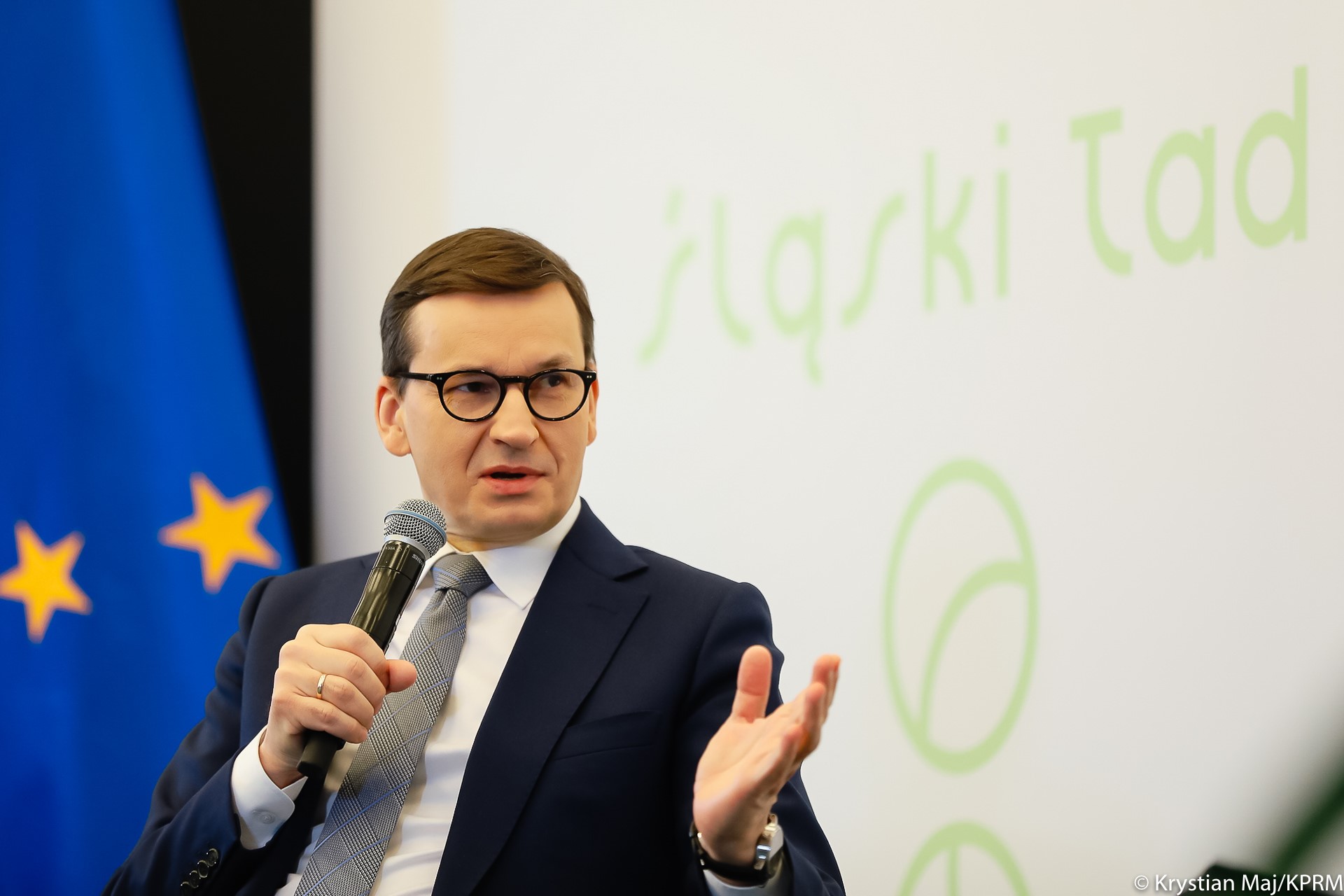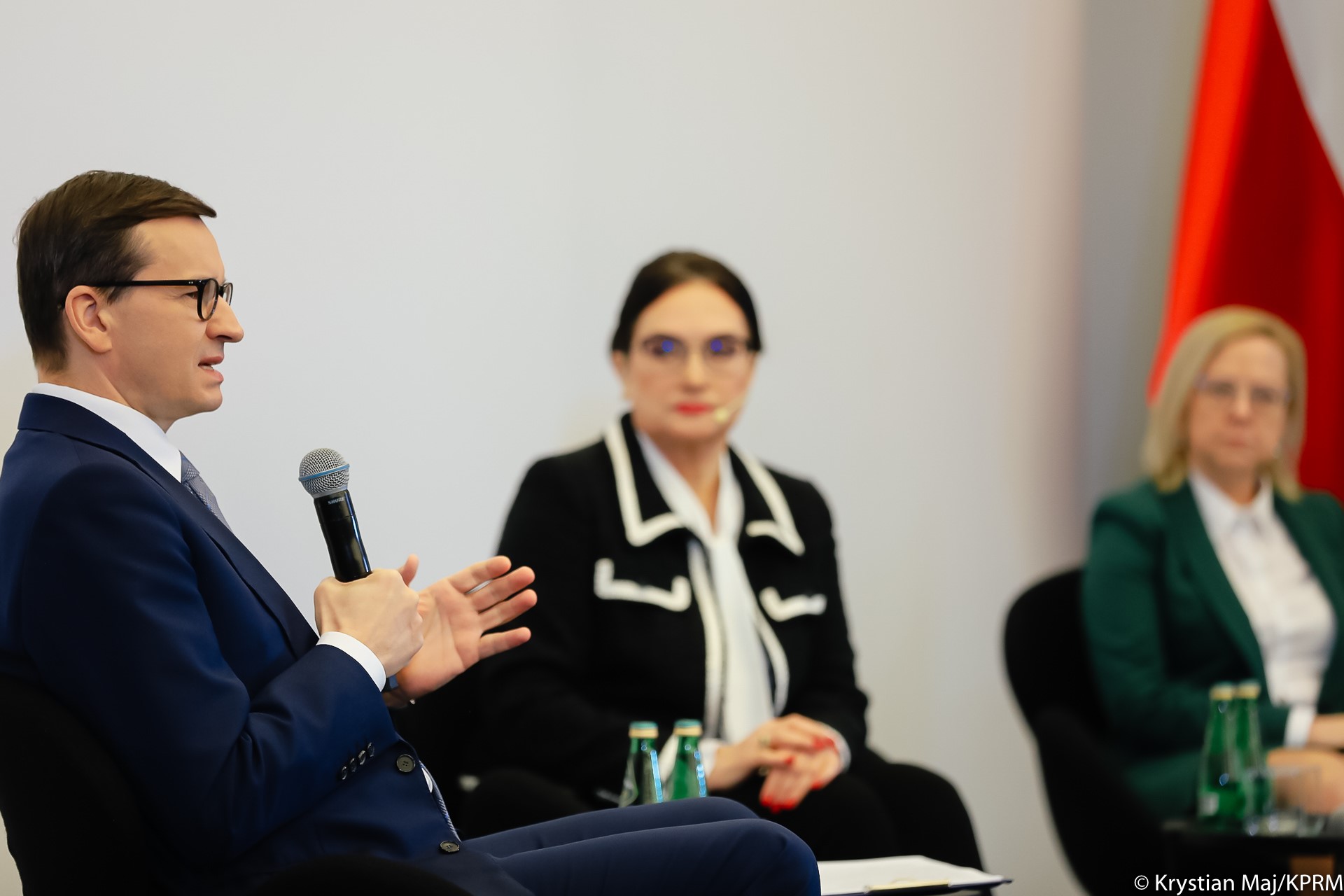
IV Programme Conference of "Śląski Ład" ("Śląsk New Deal") with the attendance of Prime Minister Mateusz Morawiecki
29.11.2021
Prime Minister Mateusz Morawiecki took part in the IV Programme Conference "Śląski Ład" ("Śląsk New Deal"). The debate focused on the role of the Carbon Border Adjustment Mechanism (CBAM) in Poland and the European Union. During the discussions, the advantages and disadvantages of the above mechanism in creating energy, economic and climate policies were presented.

"Climate policy is strongly saturated with ideology. It is difficult to engage in polemics with the ardent supporters of immediate climate neutrality or with those who say that the baton should not be taken up at all," said Prime Minister Mateusz Morawiecki.
"Śląski Ład" ("Śląsk New Deal") as part of the Green Deal of the European Union
Climate policy is the most expensive and spectacular project in the history of the European Union. The realisation of the Green Deal depends largely on the energy transition of Silesia.
The effectiveness of modernisation processes can be ensured not only by appropriate funding. It is also important to coordinate all of the activities carried out at the local, regional, national and European levels.
“We are concerned, in the difficult times we are living in - from the point of view of the implementation of climate policy assumptions and in the face of various European Union plans - about the situation of the Polish energy-intensive industry and others," said Prime Minister.
A common goal for the future of Silesia
Involvement in the energy transformation of Silesia should involve all circles. Starting from politicians, local government, trade unionists, through scientists, entrepreneurs and ending with the media. Different opinions and different approaches to the subject can lead to general benefits for all parties, not only in Silesia but in Poland and in Europe. The common denominator should be a good and secure future for Silesia.
“Poland’s way should be the middle one. We should use what is best for us. At the same time, we should respond to the needs of climate policy while preserving as many jobs as possible in the transformation of Polish industry," said Prime Minister Morawiecki.
CBAM mechanism - sustaining the competitiveness of the EU economy
The carbon border adjustment mechanism is one of the most important regulatory instruments in the energy and economic strategy of the European Union and Poland. The European Commission wants to introduce it, inter alia, in order to maintain the competitiveness of the EU economy in the era of the European Green Deal.
During the conference, researchers from the University of Economics and the Central Mining Institute in Katowice presented expert opinions on the pros and cons of CBAM in creating energy, economic and climate policies.
“CBAM, i.e. carbon border adjustment tax, may even out the chances of European industries, but on the other hand, we can already hear opinions that those who utilise steel in their work and are importers will, as a result, be in a more difficult situation,” said the Head of the Polish Government.
Raw material independence as the priority of climate policy
Poland spends between PLN 50 and 80 billion on the import of energy-intensive raw materials such as oil, gas and coal. We pay a gigantic sum from our budget to countries such as Russia, Saudi Arabia and Norway. These sums exceed the funds that our country receives from the European Union. Independence will improve our balance of payments. The government will approach the final form of the carbon footprint tax in such a way that it benefits Poland, Upper Silesia and its employees.
„Would it not be beautiful if we became independent of these raw materials? Would it not be better to pursue a policy based on independent sources, which are dependent on us?” That was the rhetorical question asked by Prime Minister Mateusz Morawiecki.
It is not only our country that imports energy raw materials, but also the entire EU. The member states of the Community spend a total of USD 300 billion on, among other things, 550 billion cubic metres of gas and 650-500 million tonnes of oil. Unfortunately, most of these raw materials are imported from across the eastern border of the European Union.
Increases in the prices of goods and services across Europe
We are already experiencing that, through price manipulation on the gas market, the marginal price in Europe has risen sharply. The high costs associated with CO2 emission allowances have also contributed to the rise. They are currently above USD 70 and have already reached the figure that the European Commission had assumed for the year 2040. These reasons are the components of the prices of various goods and services across Europe.
"Today, as a result of price manipulation, inflation is significantly higher. It is also high in Poland, the highest in 20 years, partly due to the fact that the prices of products and services include the very high costs of the European Union’s climate policy and the costs associated with price manipulation on the part of Gazprom," emphasised Prime Minister.