
Prime Minister Mateusz Morawiecki: effective fight against VAT mafias means more money for investments and social policy
22.09.2021
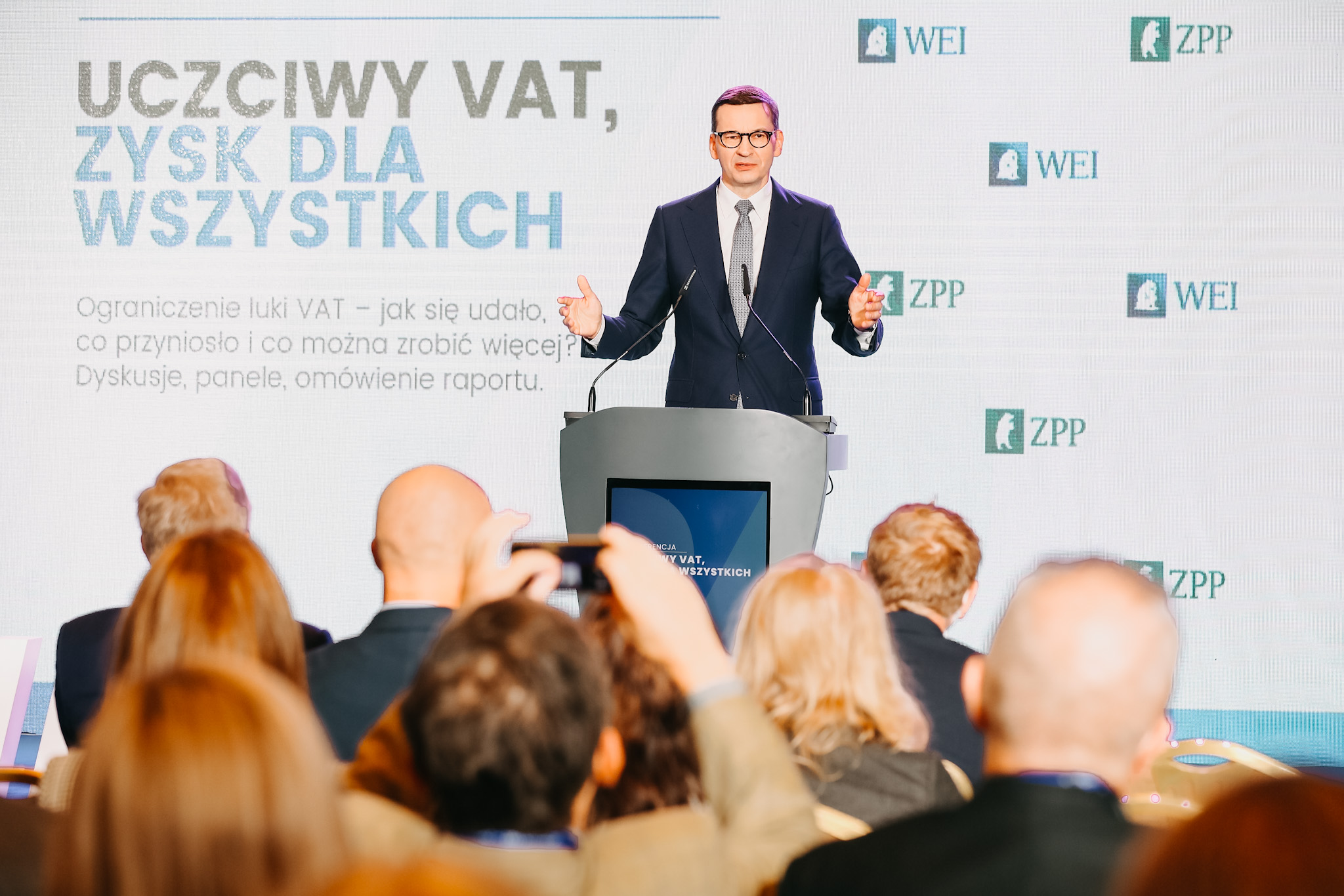
Since 2015, thanks to the government's effective measures, the VAT gap has been sharply reduced. According to the European Commission (EC), from 2015 to 2019, it shrank from 24.7 to 9.7 per cent. Now the VAT gap in Poland is lower than the EU average. “By closing the VAT gap, we have improved the state's social and investment policy capabilities. Thanks to this, we are building pro-export mechanisms. This reflects the maturity of the state,” said Prime Minister during the conference entitled “Fair VAT, profit for everyone”.

The recovered funds were used to support social and investment programmes in Poland
The funds recovered from the VAT mafias have funded social and investment programmes in recent years. The Prime Minister stressed that evidence of the effectiveness of the measures taken could be found in the budget and our social and investment policies. "Today, we have a road construction programme worth PLN 300 billion, where 80 per cent of the funds comes from domestic VAT. Through this, we can see how the efficiency of the state apparatus translates into opportunities for entrepreneurs and into the road and social infrastructure," Prime Minister continued.
It is a revolution in state budget management. Thanks to it, numerous tax reliefs have been introduced, e.g., reduction of the PIT rate from 18% to 17%, 0% PIT for the young, reduction of the VAT rate for several hundred products, reduction of the CIT rate to the lowest levels in Europe. People pay less in CIT, less in PIT and lower VAT rates - and the budget revenue is greater.
The reduction in the VAT gap is the result of effective government activities
The reduction in the VAT gap is the result of a multi-component plan that has made the activities of tax criminals, at every stage of their operations, much more difficult. Thanks to, inter alia, the actions of the Ministry of Finance, criminals have a growing problem with organising VAT carousels. Due to the fact that the system is increasingly monitored and sealed, the time in which the VAT carousel operates is shorter and shorter, it brings fewer and fewer benefits, and it is more and more difficult to "launder" funds coming from crime, i.e. to legalise them as coming from honest activity.
The tax administration was also reformed, and penalties for VAT offences were increased. The fuel and transport packages brought relief to honest entrepreneurs who previously were unable to compete with tax criminals.
Since 2017, systemic solutions have also been emerging that have started producing lasting effects. These include the split payment mechanism, the list of VAT taxpayers and electronic reporting. These also include further administrative e-services such as online cash registers, cash registers in the form of software or e-receipt.
Despite the COVID-19 outbreak, Poland has been consistently closing loopholes that were previously exploited by criminals
According to estimates presented in this year's Multiannual Financial Plan of the State (WPFP), the VAT gap in Poland in 2020 amounted to 10.8 per cent of potential revenue. Poland has the potential to reduce this ratio to around 5 per cent.
Despite the COVID-19 outbreak, Poland has been consistently closing loopholes that were previously exploited by criminals. Further actions are planned, including the implementation, as the fourth country in the EU, of e-invoicing.
The fight against VAT mafias and international cooperation
An important element in the fight against VAT mafias is the international exchange of tax information. Therefore, agreements on the transfer of knowledge, information and technology have been signed with, among others, the Visegrad Group countries. The next agreements will be concluded with the Baltic countries and the countries of Southern Europe.
In March of this year, an agreement was signed with Slovakia on the automatic exchange of VAT information. This is a new and innovative way of exchanging tax information.