News
-
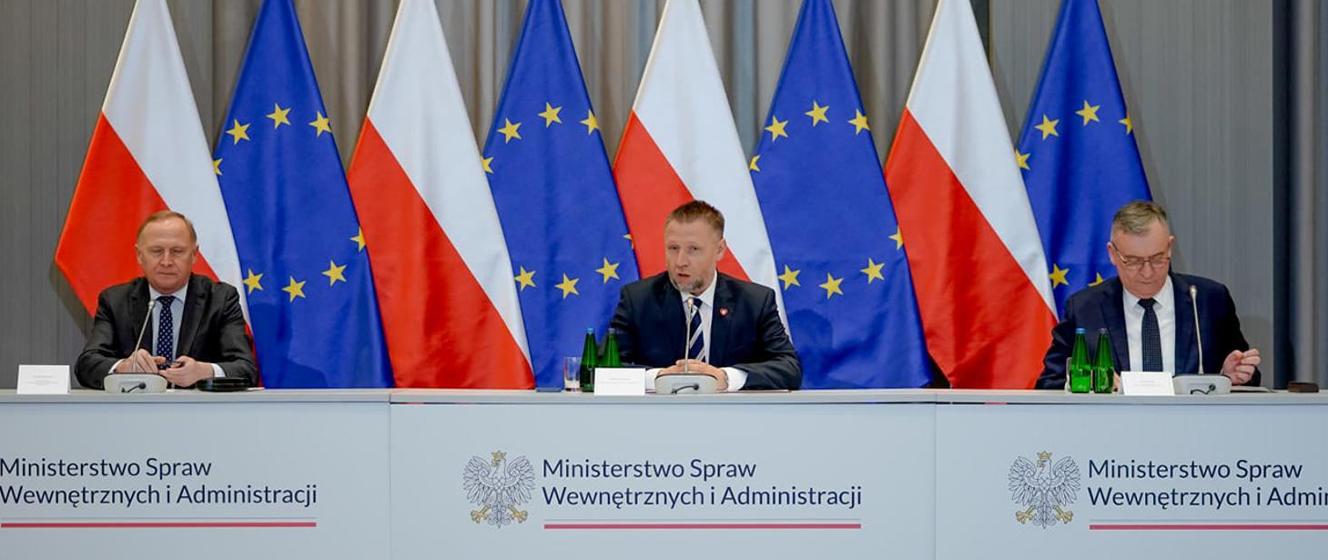
26.09.2026 MunichMinister Marcin Kierwiński presented Poland's position at the international migration summit in Munich, urging the attendees to tighten EU regulations and secure its external borders. The Minister of the Interior and Administration stated that the solutions provided for in the Migration Pact are not enough to address the current challenges. He also pointed out that Poland's border protection mechanisms - including the temporary suspension of the right to asylum in the face of hybrid pressure - can serve as a model of an effective solution to be implemented across Europe. Deputy Minister Maciej Duszczyk also attended the event.
-
04.08.2026Maciej Duszczyk, Deputy Minister of Interior and Administration, took part in an extraordinary meeting of the Council of the European Union's Justice and Home Affairs (JHA) Council, held on Tuesday (4 August). The meeting focused on the migration situation in light of recent events in Ceuta. The Deputy Minister Duszczyk emphasised that the protection of the EU's external borders must be a priority, and that illegal entry into the European Union should automatically preclude the possibility of obtaining the right of residence, and thus also the possibility of settling permanently in the future. At the same time, he outlined Poland's experience of protecting its borders against migration being exploited for political ends. Poland welcomes the fact that an increasing number of Member States share its views on migration. Migration must be subject to full control. Only this will prevent the possibility of using it against the values that underpin the EU.
-
15.06.2026The modern Eurodac system is already supporting the Police and Border Guard in their work to ensure Poland's security. Eurodac is a new-generation European system for the identification and registration of biometric data of non-EU nationals. It covers foreign nationals who apply for asylum, are apprehended while crossing the EU border illegally, or are staying illegally in the territory of a Member State. The introduction of the system strengthens the fight against illegal migration and cross-border crime.
-
09.06.2026In the first quarter of 2026, Poland issued 16,000 work visas to foreign nationals - eight times fewer than in the same period of 2022. Furthermore, we issued several dozen per cent fewer student visas, over half as many work permits, and saw a sharp rise in successful deportations. The Polish government has implemented a new, assertive and selective migration policy, the key priorities of which are the safety of its citizens and a responsible approach to migration. Thanks to the tightening of procedures and the consistent enforcement of the law, the state has regained control over who enters Poland, for what purpose, and who must leave the country. The government's approach is based on the premise that immigration must bring tangible benefits, be commensurate with the state's capacity, and not have a negative impact on social cohesion.
-
03.06.2026The Minister of Interior and Administration has signed a regulation extending the existence of the buffer zone from 3 June to 31 August 2026. This decision stems from the need to maintain the highest level of operational vigilance and ensure the high effectiveness of border protection.
-
03.06.2026Poland has successfully blocked the artificial migration route created by the Kremlin and Minsk, emerging as the EU's leader in security. At the Kuźnica Białostocka-Bruzgi border crossing, Marcin Kierwiński, Minister of Interior and Administration, met with Jim O'Callaghan, a minister from Ireland, which is due to take over the presidency of the Council of the EU in July. The meeting provided an opportunity to share Poland's experience in countering hybrid aggression and to demonstrate how we are building a secure Europe.
-
21.05.2026The safety of Polish citizens is a priority; therefore, at the request of the Ministry of Interior and Administration, the government has decided to further extend the restriction on the right to apply for international protection at the border with Belarus. The regulation, published in the Journal of Laws, extends the validity of the existing provisions from 21 May for a further 60 days.
-
18.05.2026Strengthening resilience to hybrid threats, combating cybercrime and developing an effective legal framework for bilateral cooperation - these were the main topics of the meeting between Marcin Kierwiński, Polish Minister of Interior and Administration, and Kasiviswanathan Shanmugam, Singapore's Minister for Home Affairs. Despite the geographical distance between them, both countries face similar challenges in cyberspace and in the fight against international organised crime.
-
27.04.2026Poland's eastern border has become an insurmountable barrier for illegal migrants. In the first three months of 2026, the Polish services thwarted all attempts to enter the country illegally from Belarus, achieving a 100 per cent success rate in preventing such crossings. This was announced by the Minister of Interior, Marcin Kierwiński, at a briefing for the services responsible for Poland's border security. The head of the Ministry of Interior and Administration added that in 2025, the Border Guard issued nearly 15,000 decisions ordering foreign nationals to return to their home countries - twice as many as in 2022.
-
10.04.2026The Border Guard has prevented 6,500 non-EU nationals from entering Poland, thanks to the modern Entry/Exit System (EES). The system for digitally registering only third-country nationals travelling to the Schengen Area is now operational at all 71 road, rail, air and sea border crossings in Poland. Marcin Kierwiński, Minister of Interior and Administration, together with Deputy Ministers Czesław Mroczek and Tomasz Szymański, confirmed at the Warsaw Chopin Airport that the new type of security check is now fully operational. Since 12 October 2025, that is, since the EES was first launched, the Border Guard has created over 2 million biometric profiles of foreign nationals - including their fingerprints and facial images.