
Antimicrobial sol-gel layers containing carbon nanoparticles

 Project title
Antimicrobial sol-gel layers containing carbon nanoparticles
(Project acronym – AnBaCo)
 Name of Beneficiary/Beneficiaries
Lodz University of Technology – Coordinator
Przedsiębiorstwo Produkcyjno Handlowo Usługowe TERMEX Sp. z o.o.
(No M-ERA.NET2/2019/3/2020)
(Foreign partner – Technical University of Liberec, Czech Republic – funded by TAČR Úvodní stránka – Technologická agentura ČR (tacr.cz) project No. TH71020001)
 Name of programme
International programmes
 Competition
M-ERA.NET/2019
 Project value
PLN 1,858,804.65
 Funding value
PLN 1,755,895.05
 Project delivery period
from 1 May 2020 to 30 September 2023
Meet our team
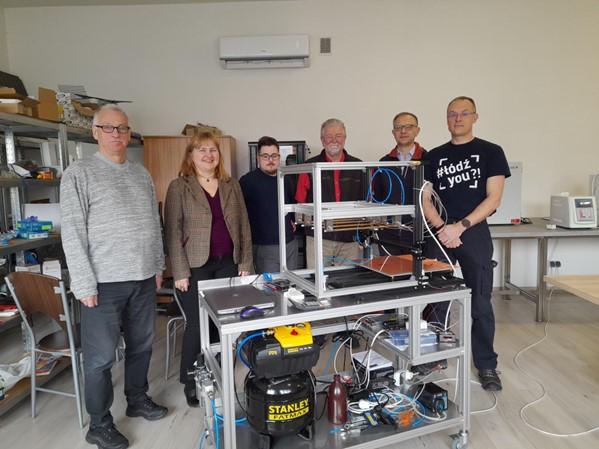
Part of the AnBaCo Team at the Portable Laboratory Workstation created in the project for the application of antibacterial layers. From left: prof. Petr Louda (Technical University of Liberec), dr inż. Anna Karczemska (coordinator, Lodz University of Technology, Institute of Fluid Flow Machinery), dr Michał Szczypiński (TERMEX company from Koszalin), prof. Stanisław Mitura (TERMEX), dr. hab. Radosław Wach (Lodz University of Technology, MITR), dr inż. Dariusz Witkowski (Lodz University of Technology, Institute of Fluid-Flow Machinery)
See the results of our work
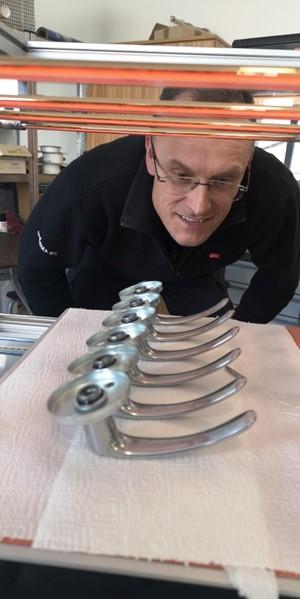
The results of our work – doorknobs with antimicrobial sol-gel layers containing nanodiamonds (during layer curing), the curing process is observed by dr inż. Dariusz Witkowski of the Lodz University of Technology.
What problem does our project solve?
The problem defined is the potential epidemiological threat caused by the spread of bacteria, which are found on various surfaces that are frequently touched by people in places such as hospitals, shops, public transport, schools, etc.
The aim of the AnBaCo project was to address the above problem by obtaining non-toxic sol-gel antimicrobial coatings that can be applied to various objects such as handles on public transport or trolleys in supermarkets, doorknobs in toilets, hospitals, etc. The well-known sol-gel film deposition technology developed by partners from the Technical University of Liberec was used, but the toxic silver, copper and zinc nanoparticles used as standard by Czech scientists were replaced with chemically modified non-toxic carbon nanoparticles.
Carbon exists in different allotropic varieties, the same carbon atoms bonded together in different ways form materials with completely different properties, for example, diamond, graphite, fullerenes, nanotubes or graphene. In recent decades, science has become increasingly interested in nanomaterials and their applications in science and everyday life. For example, nanomaterial (i.e. nanometre-sized) diamonds have interesting properties, including antibacterial properties, used in the AnbaCo project.
As part of the project, carbon nanoparticles (nanodiamonds, carbon nanotubes, graphene oxide and fullerenes) were chemically modified to obtain improved antimicrobial properties. The antimicrobial activity of the films was verified in microbiological experiments with selected bacterial strains, and the safety of the resulting products was also confirmed using specialised cell-based assays. The technology was adapted to an automated process using a Portable Laboratory Workstation designed and created under the project, developed at the TERMEX company in Koszalin in cooperation with scientists from the Lodz University of Technology.
Who will benefit from the project's results
The AnBaCo team believes that the general public can benefit from the results of the project. We are taking steps to implement the developed technology.
What was the biggest challenge for us in implementing the project?
The biggest challenge for us during the project was the COVID pandemic. It showed us, on the one hand, that the problem defined in the project (even before the pandemic), is by all means reasonable and relevant. On the other hand, for many months all research was very difficult. However, we succeeded!