
Circular Economy Accelerated Through Collaboration: The Polish-Swiss Model for Building a Resilient Industry
06.10.2026

The transition towards a circular economy requires not only new technologies and products, but above all new models of collaboration. The experience gained through the second edition of the Swiss-Polish Cooperation Programme demonstrates that lasting partnerships between enterprises and research institutions, supported by appropriate funding instruments, are crucial for developing innovations that address challenges in this field. The programme, implemented by the National Centre for Research and Development (NCBR) and the Swiss Innovation Agency Innosuisse, serves as an effective example of building a cross-border innovation ecosystem, as highlighted by participants of the Polish-Swiss Innovation Day 2026.
As Prof. Jerzy Małachowski, Director of NCBR, explained, R&D projects implemented under the Research and Innovation Programme, Applied Research component of the Swiss-Polish Cooperation Programme, cover such areas as advanced materials, energy technologies, biotechnology, digitalisation of industrial processes, and advanced manufacturing. What connects them is a shared objective: creating greater value while using fewer resources and developing future-oriented products and technologies through international cooperation. This modern innovation ecosystem was one of the key themes discussed during the Polish-Swiss Innovation Day.
Funding, Partnerships and Research
The event, held in Warsaw on 1 October 2026 under the theme “Rethinking Life Cycles Circular and Regenerative Pathways to Future-Proof Industries”, was opened by H.E. Olaf Kjelsen, Ambassador of Switzerland to Poland.
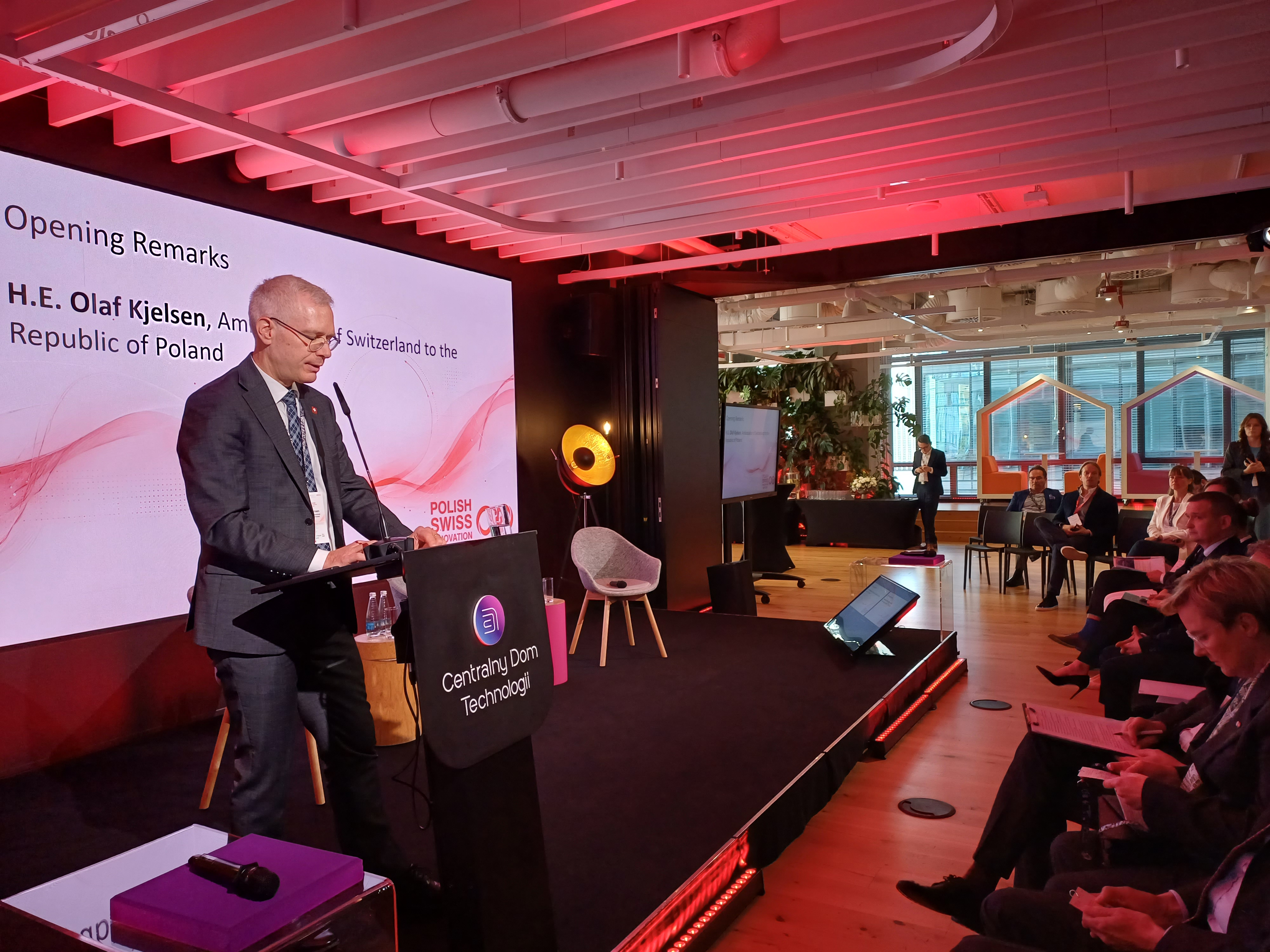
H.E. Olaf Kjelsen, Ambassador of Switzerland to the Republic of Poland
Agnès Petit Markowski, Head of the Project and Programme Funding at Innosuisse, and Prof. Jerzy Małachowski, Director of the National Centre for Research and Development, discussed how to build cross-border innovation ecosystems for a circular industry.
A circular economy requires cooperation across borders and sectors. As the speakers emphasised, the experience of the Swiss-Polish Cooperation Programme shows that the most effective innovations emerge when the strengths of science, business and international collaboration are combined to achieve a common goal.
Transitioning to a circular model involves changes throughout the entire product lifecycle, from design and manufacturing to resource recovery and reuse. According to the Director of NCBR, the shift towards a circular economy cannot succeed without cooperation, as no country or organisation possesses all the necessary competencies on its own.
“The energy transition is one of the pillars of NCBR’s new strategy. It is a great value for us that we can implement support through the SPPW programme. We recognise that the circular economy, also in Poland, is not only about new technologies, but about transforming industry from a linear to a circular model. No country can achieve this alone. Cooperation between businesses, science, start-ups, public administration and innovation funding institutions is essential,” said Prof. Jerzy Małachowski, Director of NCBR.
The desired transformation affects areas such as product design, manufacturing, logistics, resource management, and the use of data and energy. This is precisely why international partnerships are so important. For example, in the HydroProCera project funded under the SPPW, partners from Warsaw University of Technology, AGH University of Krakow, Institute of Power Engineering - National Research Institute and Empa - The Swiss Federal Laboratories for Materials Science and Technology, are jointly developing new catalysts for hydrogen production from ammonia. This cooperation illustrates how the energy transition requires a combination of materials science expertise, engineering competencies and industrial know-how developed across different countries.
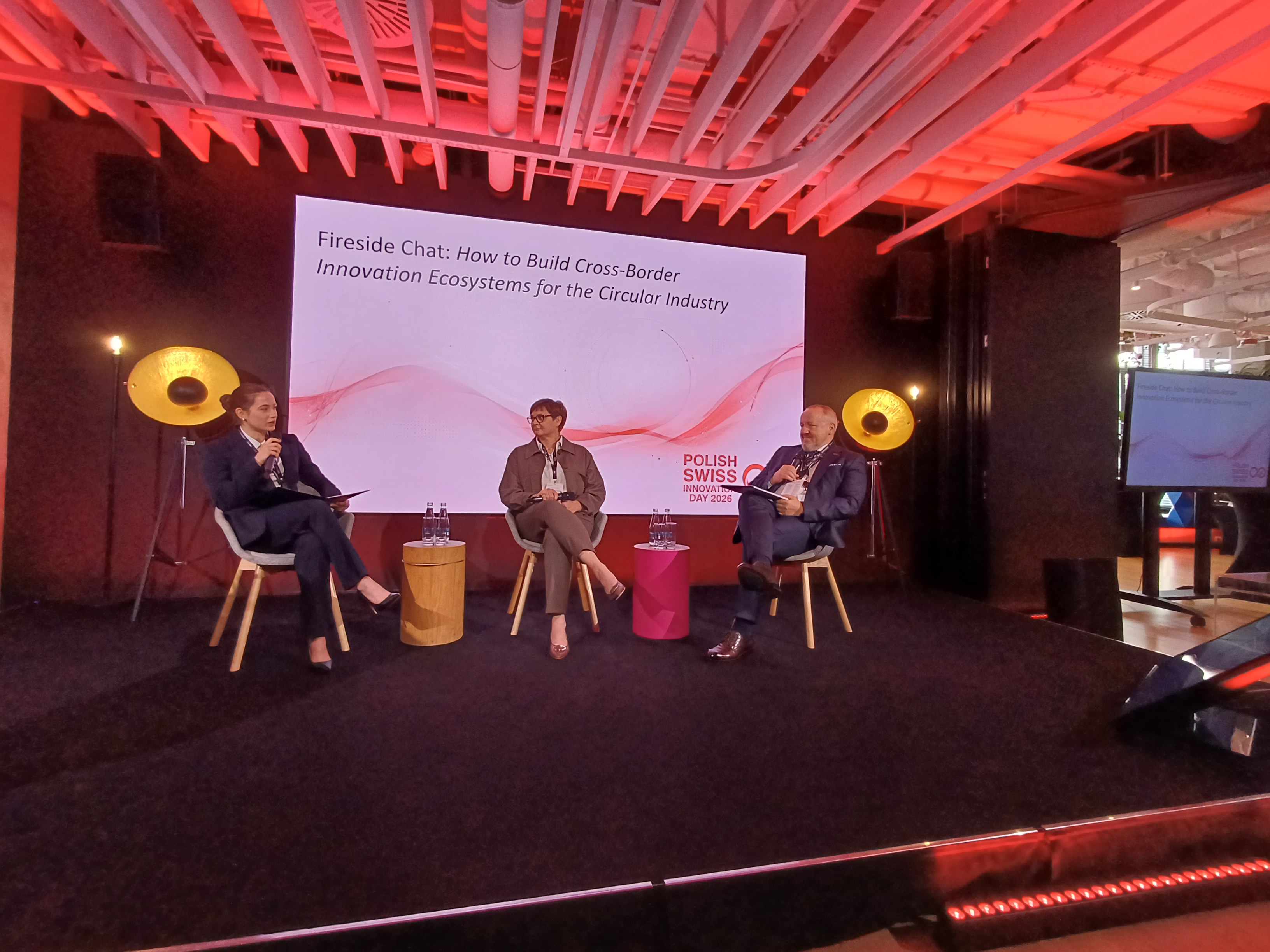
From left: Natalia Wąsowicz, Head of International Collaboration, Innovations Hub Foundation (moderator), Agnès Petit Markowski, Head of the Project & Programme Funding, Innosuisse, Jerzy Małachowski Director, NCBR
The Power of R&D Collaboration
The Swiss-Polish Cooperation Programme is a practical example of building a cross-border innovation ecosystem.
“Let us remember that people are the driving force behind innovation. Together with Innosuisse, we are already building a very stable partnership. The level of interest in the programme among Polish research organisations, businesses and Swiss partners demonstrates the strong demand for international cooperation. As a result of the 2024 Call, we received 99 applications, while the 2025 Call attracted 146 applications,” noted Prof. Jerzy Małachowski. “Many of the solutions being developed fall within the category of deep technologies.” – he added.
The programme was established to strengthen cooperation between companies and research organisations from Poland and Switzerland and to build lasting research-industry partnerships. The total Swiss contribution to the research and innovation component, including basic and applied research, amounts to CHF 35 million. Across two calls organised by NCBR, a total of 32 R&D projects submitted by companies and research organisations from both countries were recommended for funding.
Among them is the MOLCAR project, mentioned by Prof. Małachowski, implemented by Warsaw University of Technology, École Polytechnique Fédérale de Lausanne (EPFL) and Fuel Cell Poland. The partners are developing a technology for producing synthetic fuels using carbon dioxide, water and renewable energy. This is an example of cooperation bringing together science and business to address the strategic challenge of transport decarbonisation.
As participants of the Polish-Swiss Innovation Day emphasised, however, the programme’s most important outcome is not the projects themselves, but the partnerships that will continue after funding ends and serve as the foundation for future research and innovation initiatives.
Innovation Ecosystems Grow Around Businesses
One of the most significant lessons from the SPPW programme is the active involvement of companies in the R&D process, which increases the likelihood of commercialization of research results and maximizes their impact on the green transition. Currently, around 10% of Swiss companies operate to a significant extent according to circular economy principles. Participation of a business partner on both the Polish and Swiss sides was mandatory in the 2025 Call.
“Poland contributes its industrial potential, our economy is developing dynamically. At the same time, we continue to learn from our partners how to build an innovation-based economy, how to support technology transfer and implement cutting-edge solutions,” said the Director of NCBR.
Speakers stressed that the programme does not fund research for its own sake. Research problems are addressed with market applications in mind. The importance of actively engaging companies from the very beginning of the innovation process is one of the key lessons derived from bilateral cooperation.
The NCBR project portfolio includes Sph4Polym project, implemented by Alpha Powders and Swiss partners. The project originated from a specific industrial need related to the high cost of materials used in 3D printing and their limited reusability. The initiative is developing a technology for regenerating and recycling polymer powders, reducing environmental impact while improving the company’s competitiveness. Even at the research stage, a clear commercialisation pathway and strong market-readiness potential are already evident.
Circular Economy in Polish-Swiss Projects
The largest group of projects selected under the programme comes from engineering and technical sciences. They focus on areas such as advanced materials, green energy, digitalisation of industrial processes and modern manufacturing technologies.
“The project topics are highly demanding. I have no doubt that developing new solutions and sharing experience through jointly conducted research are among the greatest strengths of the Swiss-Polish Cooperation Programme,” said Prof. Jerzy Małachowski.
An analysis of the project portfolio shows that the circular economy is not a separate economic sector, but rather an approach present across numerous technological domains. Projects span materials science, energy technologies, biotechnology, industrial digitalisation and advanced manufacturing. Their common goal is to use resources more efficiently while generating economic value and reducing environmental impact.
A new approach to designing products, processes and business models can be observed in the SWEETReclaim project, where food industry by-products are transformed into functional snacks that support gut microbiota health. Meanwhile, the Sph4Polym project develops technologies for regenerating and reusing polymer powders used in 3D printing. Instead of becoming waste, these materials are returned to the production cycle. Another dimension of circularity is illustrated by the MOLCAR project, in which carbon dioxide becomes a resource for synthetic fuel production. This is an example of a circular carbon economy in practice.
The Power of Synergy
Poland has a strong industrial base and growing innovation potential, while Switzerland is among the world’s leading innovation economies and has extensive experience in translating research into commercial applications. The success of the SPPW collaboration stems largely from the complementary strengths of the two countries.
Poland contributes industrial capacity, highly skilled professionals and a rapidly developing R&D sector. Switzerland shares its expertise in building an innovation-driven economy, technology transfer and the implementation of knowledge-based solutions.
“We learn a lot from one another. Our Swiss partners provide valuable experience, particularly in developing environmentally focused innovations,” said Prof. Jerzy Małachowski.
Agnès Petit Markowski, Head of the Project and Programme Funding at Innosuisse, highlighted the scientific potential of the Polish side, the professional skills of its workforce, and the readiness and agility of Polish engineers. Combining these strengths around a common objective, supported by time, communication and mutual trust, enables the creation of projects with both strong scientific excellence and significant economic potential. Importantly, their impact will be measurable.
This complementarity is particularly evident in advanced technology projects. For example, the ASCEND project combines the expertise of Gdańsk University of Technology with the competencies of EMPA and Siloxene in next-generation battery materials. The partners are developing ceramic-composite anodes that could increase the capacity and durability of lithium-ion batteries. Each partner contributes unique and indispensable expertise.
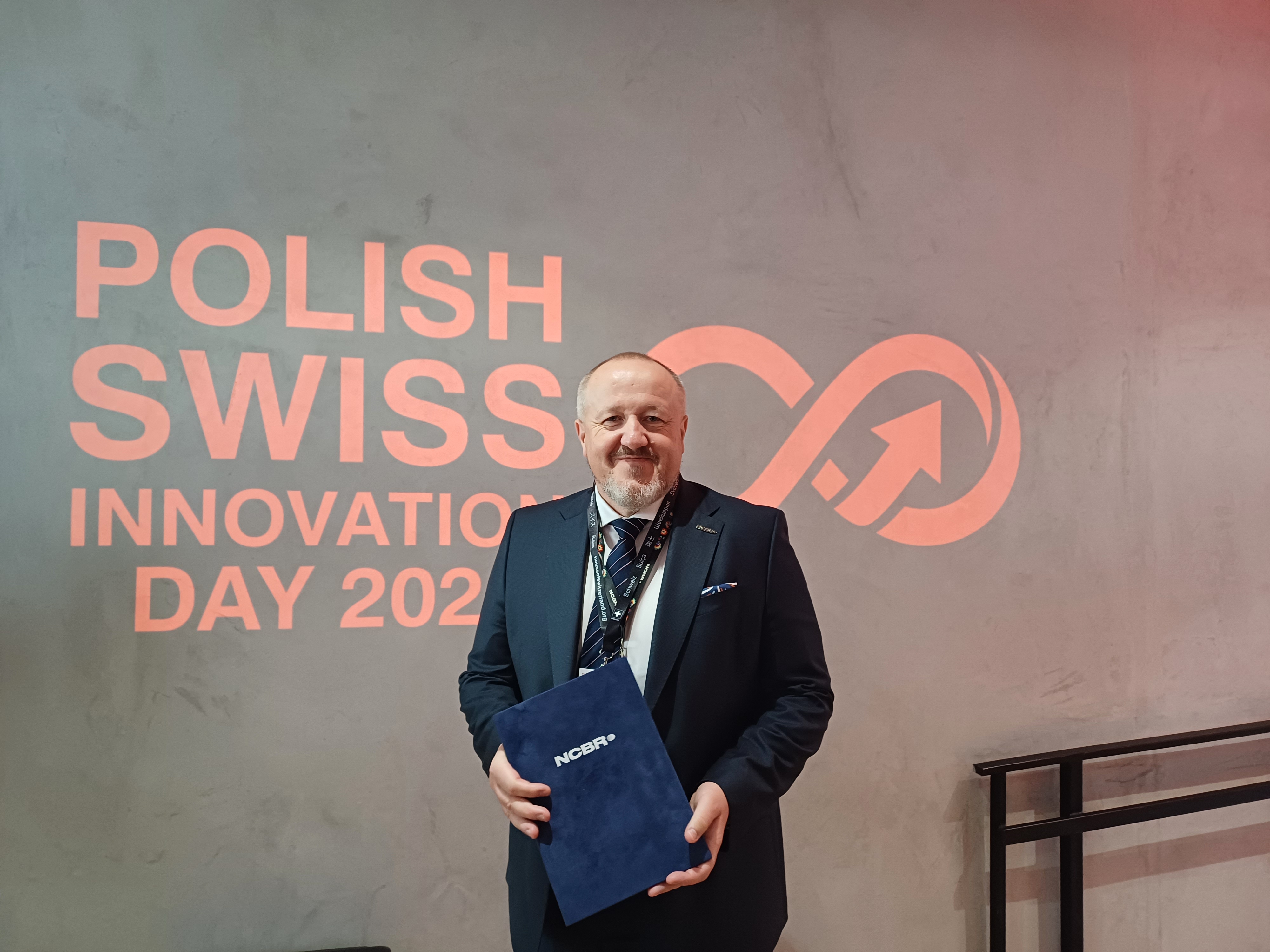
Prof. Jerzy Małachowski, Director of the NCBR, highlighted the role of international cooperation in advancing sustainable development goals.
Similarly, the QCVCSEL project, implemented by Lodz University of Technology, the Łukasiewicz Research Network – Institute of Microelectronics and Photonics, Wrocław University of Science and Technology, ETH Zurich and Airoptic Sp. z o.o., is developing a new generation of lasers for industrial gas detection systems. The Polish partners contribute expertise in photonics, microelectronics and industrial implementation, while the Swiss side brings world-class experience in fundamental research. Only by combining these strengths is it possible to pursue projects of such technological ambition.
A Source of Competitiveness and Industrial Resilience
The circular economy is not only a pathway towards environmental goals but also a powerful tool for strengthening economic competitiveness and resilience. As discussed during the Polish-Swiss Innovation Day 2026, companies that use resources efficiently, recover materials and minimise losses gain a significant competitive advantage.
Speakers emphasised that circularity is an investment in the future of industry, particularly important for Europe in light of growing competition for raw materials and energy resources.
“A large part of NCBR’s programme portfolio involves international cooperation, whose importance we greatly appreciate. It is worth emphasising that the partnerships established between Poland and Switzerland combine expertise not only from engineering sciences, but also from many highly demanding disciplines. We build these partnerships not only for specific projects but with future challenges firmly in mind,” concluded the Director of NCBR.
During the event, project leaders presented their experiences from the BEAN2CELL project (“Circular innovation in rinse-off cosmetics: functional ingredients from spent coffee grounds and microbial cellulose”) and SWEETReclaim (“Functional Snacks from Revalorised Food Side Streams - A Swiss-Polish Initiative for Sustainable Functional Sweets”). More information about these projects and their progress can be found in the accompanying publication “Polish-Swiss Partnerships Driving Innovation for a Circular Future".
The Polish-Swiss Innovation Day 2026 demonstrated that the circular economy is both one of the greatest challenges and one of the greatest opportunities facing European industry. The cooperation between NCBR and Innosuisse proves that international partnerships are powerful drivers of innovation and long-term economic competitiveness.