
Development of an innovative active harmonic filter with silicon carbide (SiC) transistors and lossless du/dt mitigation circuits designed for medium voltage industrial networks

 Project title
Development of an innovative active harmonic filter with silicon carbide (SiC) transistors and lossless du/dt mitigation circuits designed for medium voltage industrial networks
 Name of Beneficiary/Beneficiaries
MMB Drives Sp. z o.o.
 Name of programme
Smart Growth Operational Programme
 Competition
Fast Track
 Project value
PLN 3,683,568.75
 Funding value
PLN 2,781,869.50
 Project delivery period
From 1 September 2021 to 31 December 2023
Meet our team
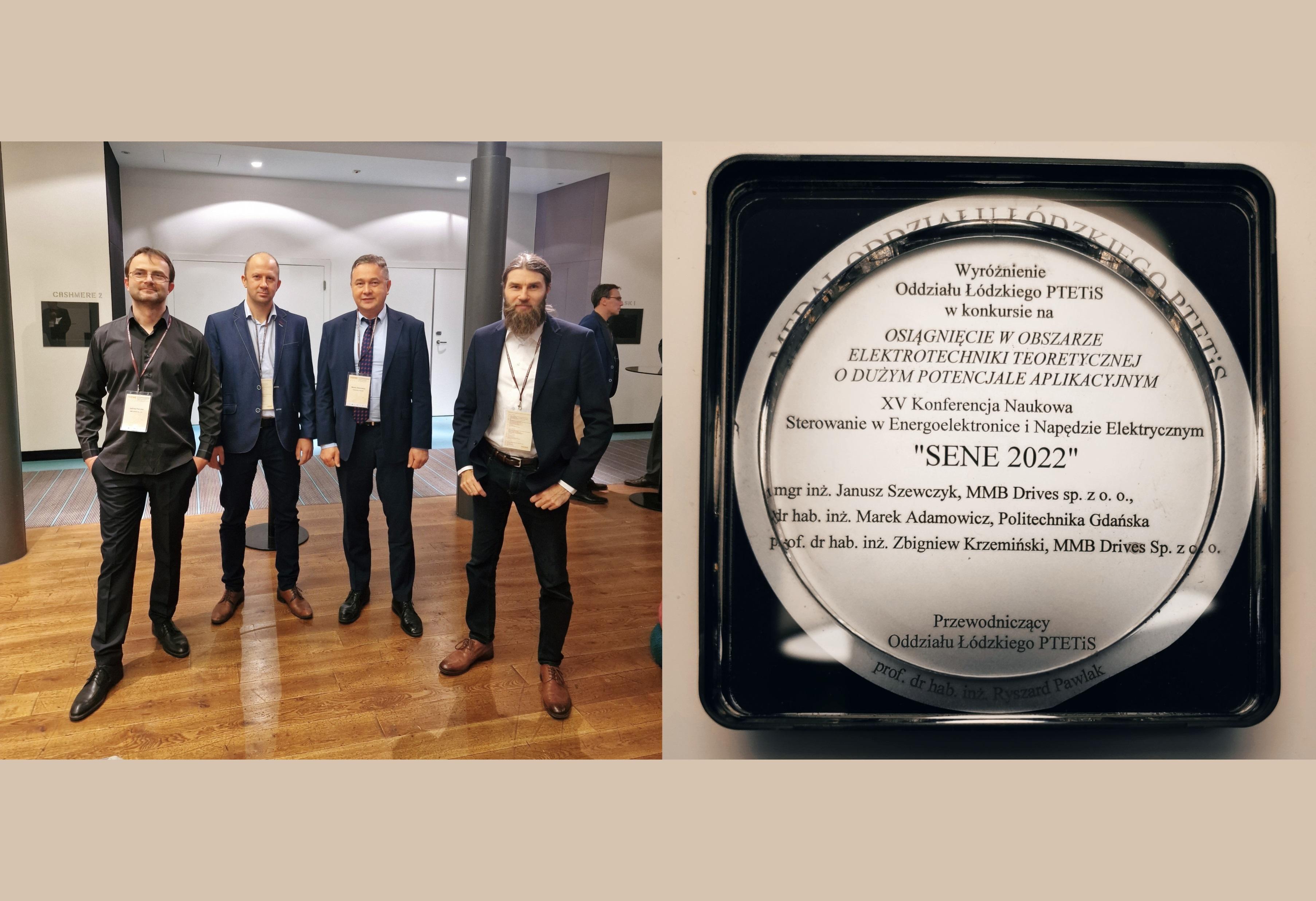
Photo 1. MMB Drives R&D team, from the right: mgr inż. Janusz Szewczyk – leader of active harmonic filter technology and creator of the control method for the developed active filter, dr hab. inż. Marek Adamowicz – R&D project manager, dr inż. Sebastian Giziewski and mgr inż. Jędrzej Pietryka. Other members of the R&D team: dr inż. Krzysztof Kowalewski, mgr inż. Mariusz Rutkowski, mgr inż. Bartosz Kołpacki, mgr inż. Piotr Pancewicz, mgr inż. Marcin Szostak, mgr inż. Mateusz Karpiczenko, inż. Roman Jurysta, Robert Dobieglewski, Jarosław Jurysta, Jacek Małecki. On the right: Medal from the Polish Society of Theoretical and Applied Electrical Engineering for the patented system and control method.

Photo 2. Prof. dr hab. inż. Zbigniew Krzemiński – President of MMB Drives, member of the R&D team, scientific mentor, and creator of control methods for power electronic converters.
See the results of our work

The developed SiC 3.3kV Active Harmonic Filter with 250 kVA power on a test bench with a programmable load bank generating higher harmonic currents in the test industrial network with a closed energy loop up to the 50th harmonic.
Video
What problem does our project solve?
Currently, industrial medium-voltage networks are exposed to interference caused by high-power inverters operating in industrial processes, photovoltaic farms, and wind farms connected to industrial networks. The source of these disturbances is the operation of IGBT transistors at relatively low switching frequencies, around 2kHz or lower, which generates harmful higher harmonic currents in the network. The operation of IGBT transistors at a 2kHz frequency produces currents of the 40th harmonic. Similarly, the operation of 24-pulse rectifiers in heavy industrial drives generates currents of the 47th and 49th harmonic. Currents of harmonics above the 31st are not currently compensated in medium-voltage networks. This is due to the lack of fast-switching transistor technology in medium-voltage harmonic filters available on the market. Higher harmonic currents cause several negative effects on industrial plants, airports, railway stations, hospitals, data centres and other public facilities powered by medium-voltage networks. The most troublesome effects include failures in control circuits, malfunctioning of protective equipment, cable and transformer insulation damage, capacitor bank overheating, and loss of communication in SCADA systems.
The 250 kVA Active Harmonic Filter developed as part of the Project has a 9-level inverter construction with ultra-fast SiC transistors. It can operate in 3.3kV and 6kV industrial networks. To achieve ultra-fast switching of SiC MOSFET transistors without the undesirable electromagnetic compatibility (EMC) phenomena associated with such fast switching, lossless circuits for mitigating the steepness of du/dt voltage changes in SiC MOSFET transistors were developed and applied as part of the Project. This innovative solution on a global scale is protected by a patent application.
Who will benefit from the project's results?
Project results will be implemented into production by MMB Drives Sp. z o.o. The developed Active Harmonic Filter with fast SiC transistors, which provides filtration of higher harmonics and compensation for inductive/capacitive reactive power, offers a solution for industrial plants, airports, train stations, hospitals, data centres, energy storage facilities, and public utility facilities exposed to disturbances from photovoltaic and wind farms, as well as heavy industrial drives. It ensures high reliability and power quality.
What was the biggest challenge for us in implementing the project?
The biggest challenge in the project was understanding and mastering the wide range of physical processes occurring in real medium-voltage industrial networks with connected high-power power electronic converters. Another challenge was developing and launching test benches with model industrial networks of 3.3kV and 6kV, ensuring high representativeness of the obtained industrial research and experimental development work results.
Our advice to other Applicants
We advise Applicants to precisely indicate in their project Applications the methods of verifying the achievement of planned indicators and Milestones, and to ensure proper attention to patent purity of the proposed solutions and protection of intellectual property rights for solutions developed within the projects.